
The short version
- The stage describes the size of the cancer and how far it has spread. Breast cancer stages go from 1 to 4.1
- The grade describes how the cells look under a microscope, from grade 1 (slower-growing) to grade 3 (faster-growing).1
- Stage and grade, along with receptor results, help your team plan treatment.
Grade
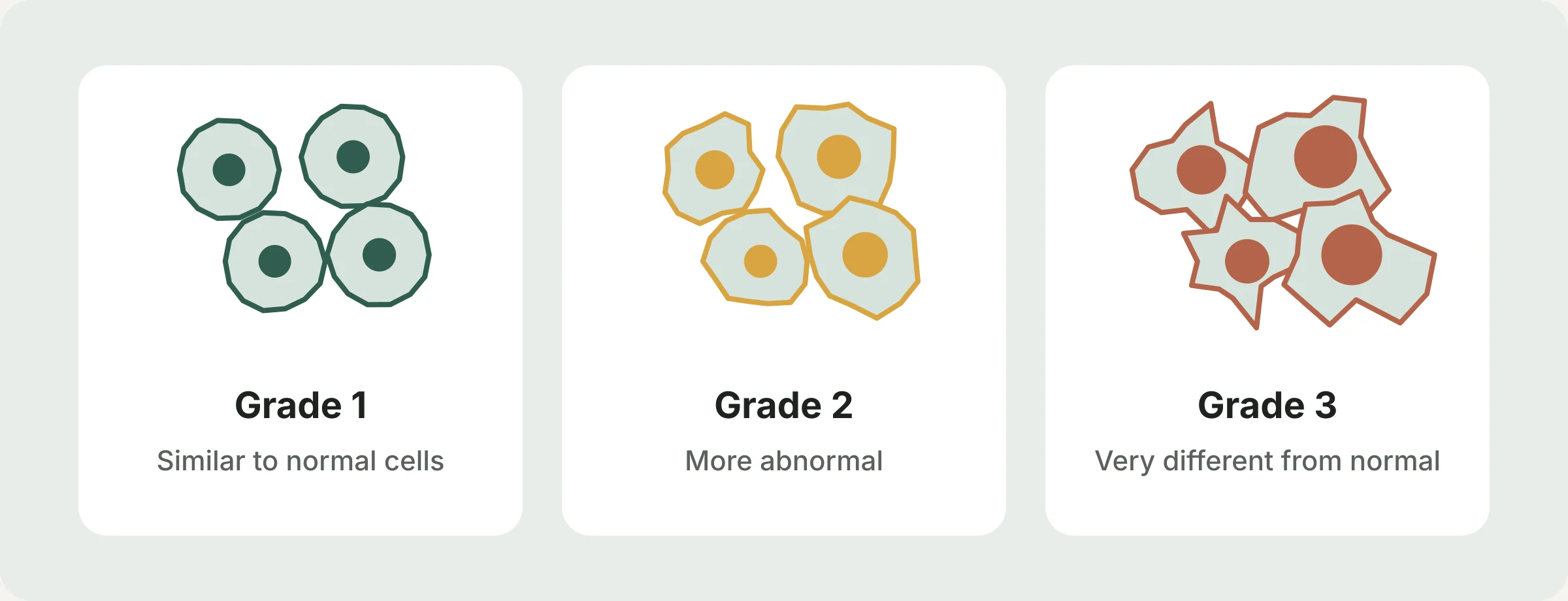
| Grade | What it means |
|---|---|
| Grade 1 (low) | Cells look similar to normal cells and usually grow slowly.1 |
| Grade 2 (intermediate) | Cells look more abnormal and grow slightly faster.1 |
| Grade 3 (high) | Cells look very different from normal cells and may grow more quickly.1 |
Stage
| Stage | What it usually means |
|---|---|
| Stage 1 | The cancer is 2cm or smaller. In stage 1B, tiny numbers of cancer cells are found in lymph nodes in the armpit.1 |
| Stage 2 | The cancer is up to 5cm and has spread to 1 to 3 nearby lymph nodes, or is larger than 2cm without spread to the nodes.1 |
| Stage 3 | Also called locally advanced. The cancer has spread to more lymph nodes, the skin of the breast or the chest muscle.1 |
| Stage 4 | Also called secondary or metastatic breast cancer. The cancer has spread to other parts of the body, such as the bones, liver or lungs.1 |
DCIS is sometimes called stage 0, because the cells haven’t spread outside the ducts.
The TNM system
Your report may use the TNM system:1
- T is the size of the tumour.
- N is whether the cancer has spread to lymph nodes, and which ones. N0 means no nodes are affected.
- M is whether the cancer has spread to other parts of the body. M0 means it hasn’t.
What it means for you
Stage and grade are only part of the picture. Your treatment and outlook also depend on whether the cancer has hormone receptors or HER2, your general health, and how the cancer responds to treatment. Your team can explain what your results mean for you.
Related pages
- Understanding your pathology report
- Types of breast cancer explained
- Common breast cancer treatment pathways
Everyone’s treatment is different, so talk to your cancer team about what is right for you.
References
- Macmillan Cancer Support. Staging and grading of breast cancer. www.macmillan.org.uk/cancer-information-and-support/breast-cancer/staging-and-grading-of-breast-cancer