
The short version
- Breast cancer is described in two main ways: by where it started and how the cells look (for example “no special type” or lobular), and by what the cancer cells respond to (hormone receptors and HER2).1
- The most common type is invasive breast cancer of no special type (NST), about 7 to 8 in 10 breast cancers.1
- Your type helps your team choose the treatments that will work best for you.
Types by where the cancer started
| Type | What it means |
|---|---|
| Invasive breast cancer, no special type (NST) | The most common type, about 70 to 80% of breast cancers. It used to be called invasive ductal carcinoma.1 |
| Invasive lobular breast cancer | Starts in the lobules (milk-producing glands). About 10 to 20% of invasive breast cancers. It often causes thickening rather than a lump and can be harder to see on a mammogram, so an MRI scan may be used.1 |
| DCIS (ductal carcinoma in situ) | The earliest form of breast cancer. The abnormal cells are inside the ducts and haven’t spread into the surrounding breast tissue. It’s often found through screening.1 |
| Inflammatory breast cancer | Rare. Cancer cells block tiny channels in the skin of the breast, making it red, swollen and inflamed.1 |
| Paget’s disease of the breast | A red, scaly rash on the nipple, which may happen alongside DCIS or invasive cancer.1 |
LCIS (lobular carcinoma in situ) isn’t breast cancer. It’s a change in the cells of the lobules that slightly increases the risk of breast cancer later. Most people with LCIS don’t get breast cancer.1
Types by receptors
Tests on the cancer cells show whether they have receptors that help them grow. These results are very important for choosing treatment. See understanding your pathology report.
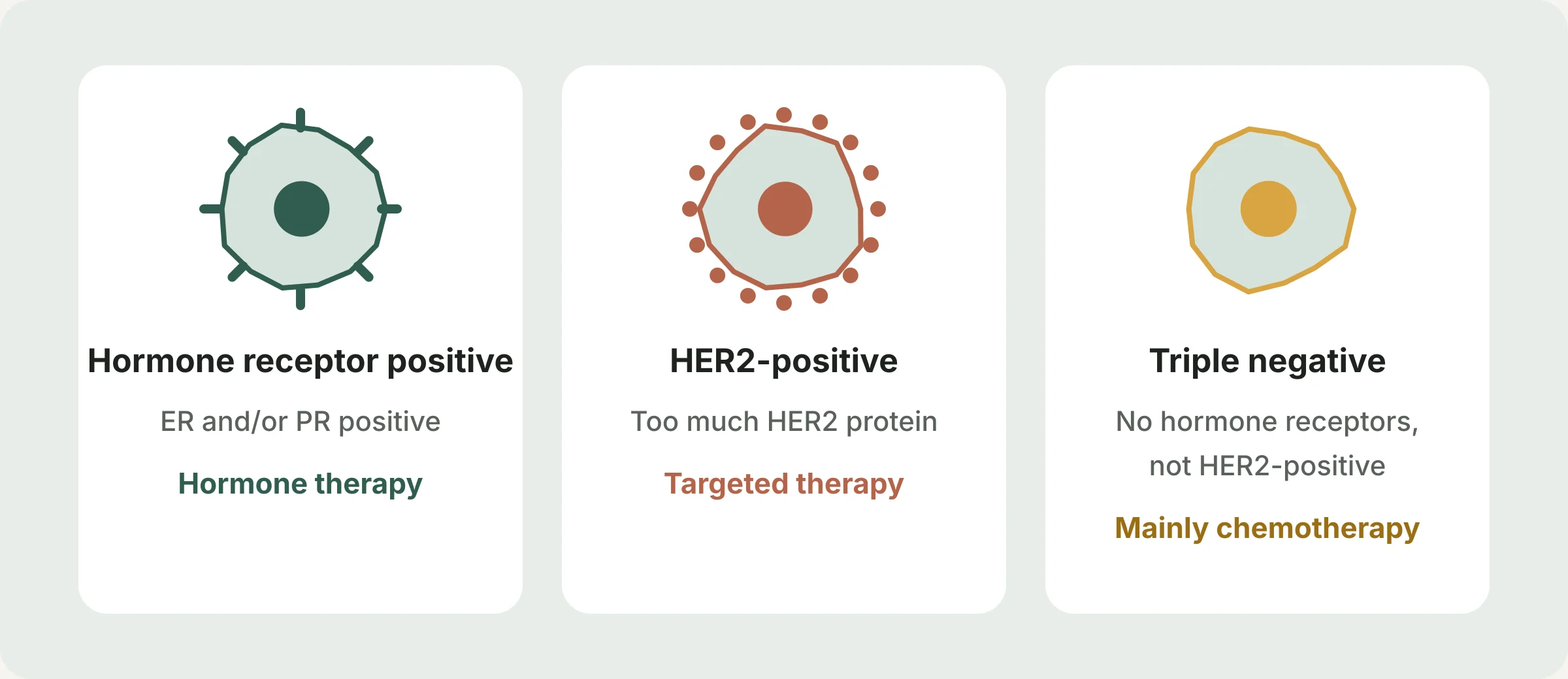
- Hormone receptor positive (ER-positive, and often PR-positive): oestrogen can help the cancer grow. Hormone therapy is usually part of treatment. About two-thirds of breast cancers have these receptors.2, 3
- HER2-positive: the cancer cells have too much of a protein called HER2. Targeted therapy, such as trastuzumab, is usually part of treatment.1
- Triple negative: the cancer doesn’t have hormone receptors or too much HER2. About 15% of breast cancers are triple negative. It’s more common in women under 40 and in Black women. Treatment is usually surgery, chemotherapy and radiotherapy, sometimes with immunotherapy.4
A cancer can be both hormone receptor positive and HER2-positive.
Primary and secondary breast cancer
- Primary breast cancer is in the breast, and may have spread to lymph nodes in the armpit.
- Secondary (metastatic) breast cancer has spread to other parts of the body, such as the bones, liver or lungs.5 See living with secondary breast cancer.
Questions to ask your team
- What type of breast cancer do I have?
- Is it hormone receptor positive? Is it HER2-positive?
- What does this mean for my treatment?
- Can I have a copy of my pathology report?
Related pages
- Understanding your pathology report
- Breast cancer stage and grade
- Common breast cancer treatment pathways
Everyone’s treatment is different, so talk to your cancer team about what is right for you.
References
- Macmillan Cancer Support. Types of breast cancer. www.macmillan.org.uk/cancer-information-and-support/breast-cancer/types-of-breast-cancer
- Breast Cancer Foundation NZ. Understanding your pathology report. www.breastcancerfoundation.org.nz/breast-cancer/tests-and-diagnosis/understanding-your-pathology-report
- Breast Cancer Now. Hormone (endocrine) therapy. breastcancernow.org/about-breast-cancer/treatment/hormone-endocrine-therapy
- Cancer Research UK. Triple negative breast cancer. www.cancerresearchuk.org/about-cancer/breast-cancer/types/triple-negative-breast-cancer
- Macmillan Cancer Support. Staging and grading of breast cancer. www.macmillan.org.uk/cancer-information-and-support/breast-cancer/staging-and-grading-of-breast-cancer