
The short version
- Your care is planned by a multidisciplinary team (MDT) of specialists, who meet regularly to discuss each person’s results and treatment.1
- Your breast care nurse (clinical nurse specialist, sometimes called your key worker) is your main point of contact, and coordinates your care.2, 1
- Keep a note of everyone’s names and numbers, including your 24-hour treatment helpline.
Who’s in the team
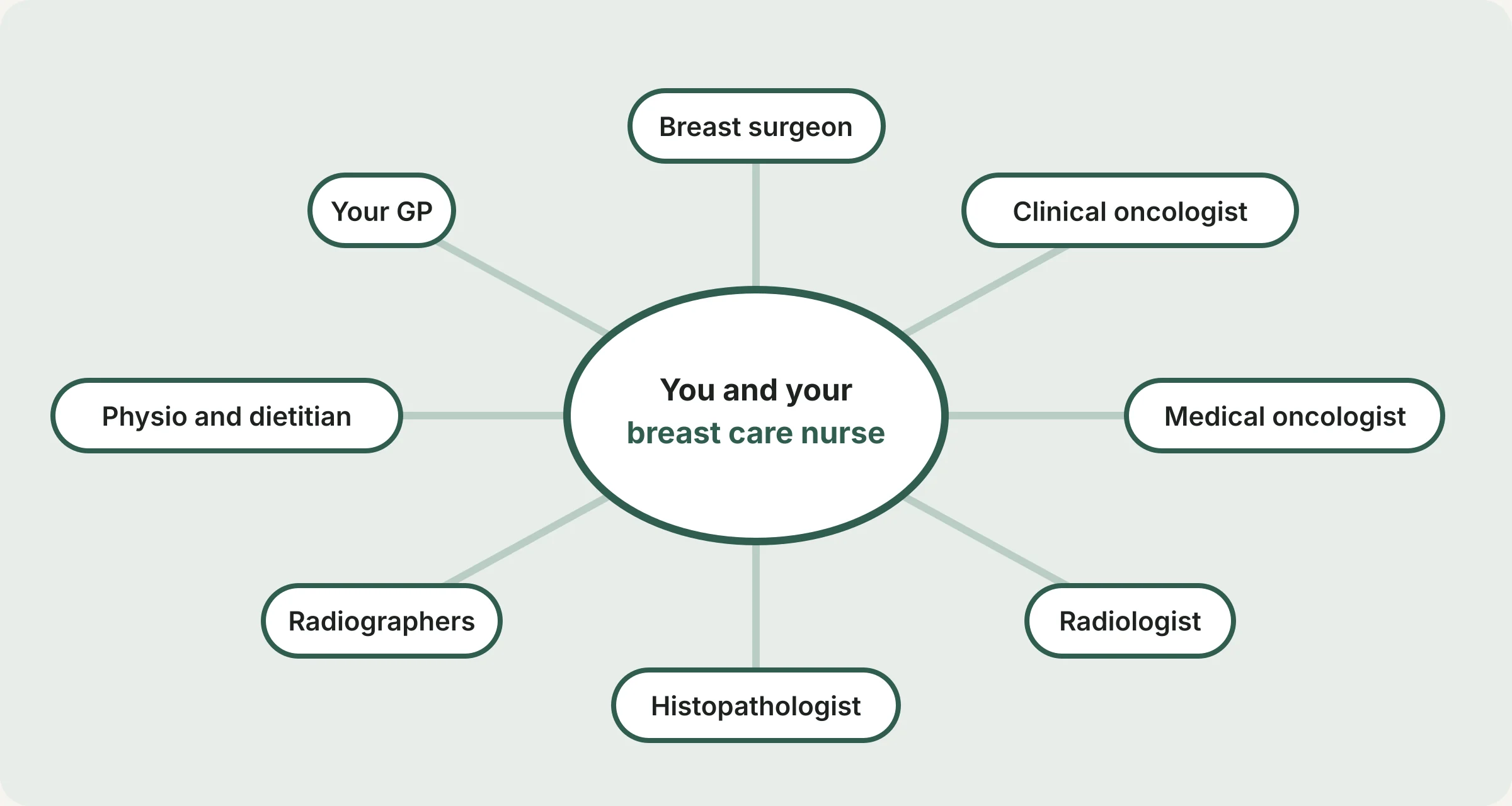
A breast cancer MDT usually includes:1
| Who | What they do |
|---|---|
| Breast care nurse (clinical nurse specialist or key worker) | Your main contact. Coordinates your care, gives support and information, and gives you a helpline number |
| Breast surgeon | Carries out surgery, such as lumpectomy, mastectomy and lymph node surgery |
| Clinical oncologist | Specialist in radiotherapy, and often other cancer treatments |
| Medical oncologist | Specialist in chemotherapy, hormone therapy and targeted therapy |
| Radiologist | Reads mammograms, ultrasound and other scans, and may take biopsies |
| Histopathologist | Examines tissue samples to work out the type of cancer and its features |
| Radiographers | Carry out mammograms and other scans, and deliver radiotherapy |
| Plastic or reconstructive surgeon | Carries out breast reconstruction, in some hospitals |
| Support workers and pathway coordinators | Help organise appointments and support |
You may also see allied health professionals, such as a physiotherapist, dietitian, occupational therapist or lymphoedema specialist, and psychological support. See what cancer rehabilitation is.
Your GP
Your GP gets letters about your diagnosis and treatment, and an end of treatment summary when treatment finishes.3 They can help with other health problems, medicines, and support during and after treatment.
How the MDT works
The team meets regularly, often weekly, to discuss each person’s results and plan their treatment. They then talk the options through with you.1 You’re part of the decision: it’s fine to ask questions, take time to think, or ask for a second opinion.
Tips
- Ask for your breast care nurse’s name and number at your first appointment.
- Ask for the 24-hour helpline number if you’re having chemotherapy or other treatment.
- Keep a contacts list on your phone or in a notebook.
- Ask who to contact for different things: symptoms, appointments, results, and support.
Related pages
- Just diagnosed: your first two weeks
- Breast cancer helplines and who to call
- Questions to ask after a breast cancer diagnosis
Everyone’s treatment is different, so talk to your cancer team about what is right for you.
References
- University Hospitals Sussex NHS Foundation Trust. An introduction to the MDT for breast cancer. www.uhsussex.nhs.uk/wp-content/uploads/2025/03/An-introduction-to-the-MDT-for-breast-cancer.pdf
- NHS. Tests and next steps for breast cancer in women. www.nhs.uk/conditions/breast-cancer-in-women/tests-and-next-steps-for-breast-cancer-in-women/
- Calderdale and Huddersfield NHS Foundation Trust. End of treatment summary. cht.nhs.uk/services/clinical-services/oncology/end-of-treatment-summary