
The short version
- Cancer rehabilitation helps you get back as much strength, function and wellbeing as possible after cancer and its treatment.
- It can involve physiotherapists, occupational therapists, dietitians, lymphoedema specialists and psychological support.1
- Ask your breast care nurse or GP what’s available locally. There are also free charity courses and paid digital programmes.
What rehabilitation is for
Treatment for breast cancer can leave you with after-effects such as tiredness, a stiff shoulder, weaker muscles, weight changes, lymphoedema, poor sleep, low mood and worry. Rehabilitation aims to reduce these effects so you can get on with your life, whether that means returning to work, caring for others, or getting back to the things you enjoy.
Macmillan describes rehabilitation as a central part of cancer care that can start at diagnosis and continue through treatment and beyond.1 When it starts before treatment, it’s often called prehabilitation.
Who can help
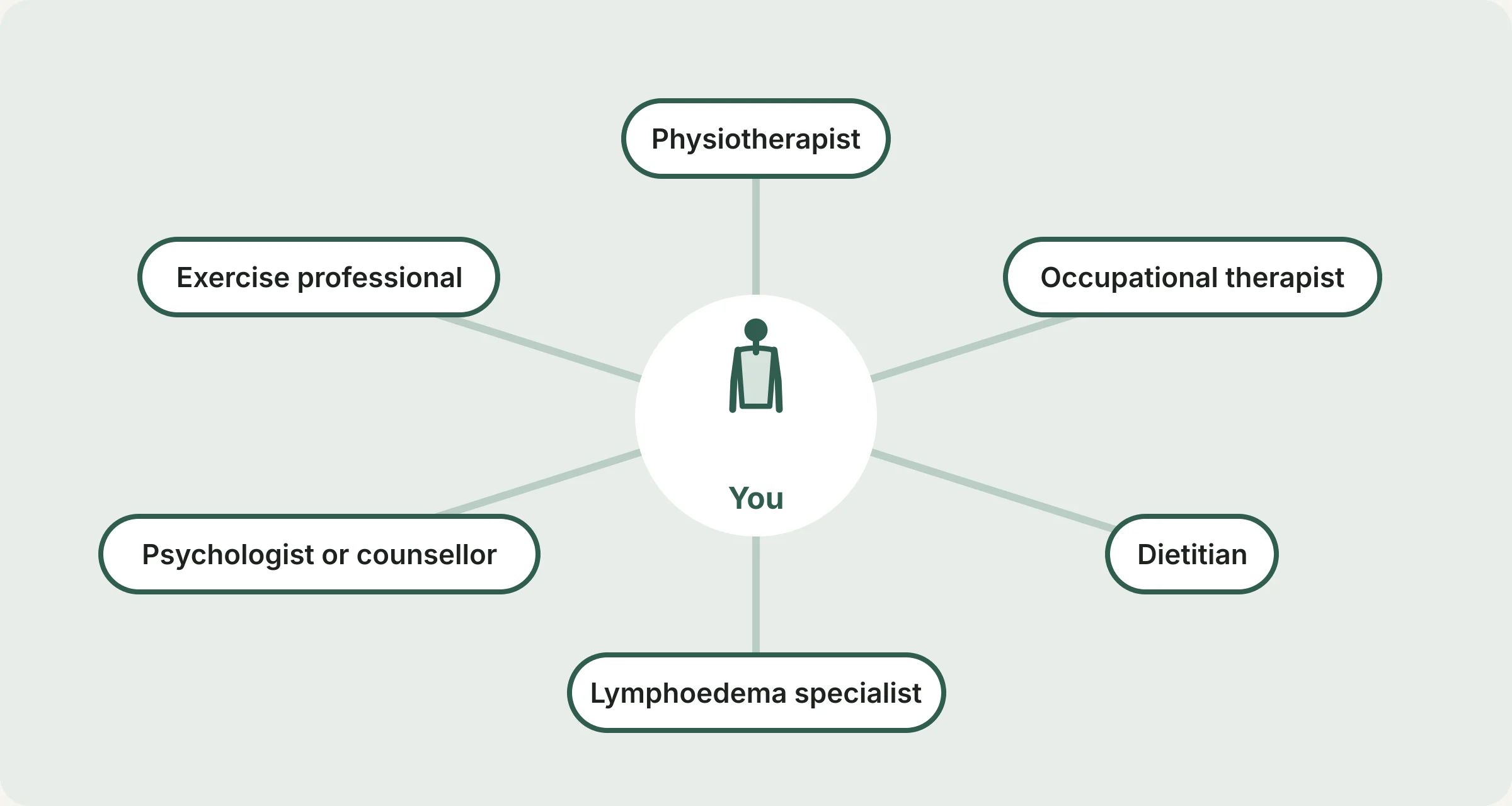
- Physiotherapists help with shoulder movement, strength, fitness and pain.
- Occupational therapists help with fatigue, everyday tasks and getting back to work.
- Dietitians help with weight changes and eating well.
- Lymphoedema specialists assess and treat swelling.
- Psychologists and counsellors help with anxiety, low mood and fear of the cancer coming back.
- Exercise professionals with cancer training can run classes or one-to-one sessions.1
What the evidence shows
Research shows that being active during and after cancer treatment improves fatigue, anxiety, depression, physical function and quality of life, and that exercise does not make lymphoedema worse.2 For people who had surgery to the armpit, a structured exercise programme after surgery improved arm function and reduced pain a year later.3
How to get rehabilitation
On the NHS. Ask your breast care nurse, cancer team or GP. What’s available varies by area: some hospitals have cancer rehabilitation teams, and others refer you to physiotherapy, lymphoedema or psychology services. Your Holistic Needs Assessment is a good time to ask.4
From charities. Breast Cancer Now’s free Moving Forward course covers wellbeing, activity, eating well and other topics after treatment.5 Local cancer support centres and leisure centres may run exercise classes for people after cancer.
Digital programmes. Personalised programmes that you follow at home through an app, with coaching. Some are available through the NHS in some areas, through an employer, or by paying yourself. Read digital rehabilitation: recovery support at home and compare UK programmes.
A personalised option: QuestPrehab Recover
QuestPrehab Recover is a four-week personalised rehabilitation programme for adults in the UK who have had cancer treatment, covering exercise, nutrition, mind and sleep with support from coaches. It costs £199, and you don’t pay until the team has confirmed the programme is right for you.6 QuestPrehab is also used by NHS hospitals for prehabilitation.7 Read our guide to QuestPrehab Recover. Why we mention QuestPrehab.
Questions to ask your team
- Is there a cancer rehabilitation or physiotherapy service I can be referred to?
- Can I see a dietitian, or a lymphoedema specialist?
- Are there exercise classes for people after cancer near me?
- Who can I talk to about how I’m feeling?
Related pages
Everyone’s treatment is different, so talk to your cancer team about what is right for you.
References
- Macmillan Cancer Support. Cancer rehabilitation pathways. www.macmillan.org.uk/assets/macmillan-cancer-rehabilitation-pathways.pdf
- Campbell KL, Winters-Stone KM, Wiskemann J, et al. Exercise guidelines for cancer survivors: consensus statement from international multidisciplinary roundtable. Medicine & Science in Sports & Exercise. 2019;51(11):2375–2390. doi.org/10.1249/MSS.0000000000002116
- Bruce J, Mazuquin B, Canaway A, et al. Exercise versus usual care after non-reconstructive breast cancer surgery (UK PROSPER): multicentre randomised controlled trial and economic evaluation. BMJ. 2021;375:e066542. doi.org/10.1136/bmj-2021-066542
- Macmillan Cancer Support. What is a Holistic Needs Assessment (HNA)? www.macmillan.org.uk/cancer-information-and-support/treatment/coping-with-treatment/holistic-needs-assessment-hna
- Breast Cancer Now. Moving Forward: support after breast cancer treatment. breastcancernow.org/support-for-you/moving-forward
- QuestPrehab. QuestPrehab Recover: personalised cancer rehabilitation. Accessed November 2026. questprehab.com/recover/
- QuestPrehab. QuestPrehab for the NHS. Accessed November 2026. questprehab.com/nhs/