
The short version
- This is a gradual 12-week plan to rebuild strength and fitness after breast cancer treatment, using simple exercises you can do at home.
- It builds towards the amounts shown to help after cancer: strength exercise two or three times a week, and regular moderate activity such as brisk walking.1, 2
- Check with your team first, especially if you’ve had recent surgery, have lymphoedema, bone problems, or heart or lung conditions.
Before you start
- Talk to your team or GP if you’re unsure whether this plan suits you. Ask your breast care nurse or physiotherapist about any limits on lifting with your arm, especially if you’ve had reconstruction.
- Keep doing your shoulder exercises if you’ve been given them. See arm and shoulder exercises after breast surgery.
- If you have lymphoedema, wear your compression garment if you’ve been advised to, and build up arm exercises slowly. Read strength training after breast cancer.
- Check your starting point. Count how many times you can stand up from a chair and sit down again in 30 seconds, without using your hands. Write it down and check again at weeks 6 and 12.
How hard should it feel?
Aim for moderate effort: you’re breathing faster and feel warmer, but you can still talk. For strength exercises, the last two or three repetitions of each set should feel like hard work, but you should still be able to keep good form. If you’re very tired, do less that day, or rest. See when to rest.
The exercises
Do these in each strength session. Instructions for each are on our strength exercises page.
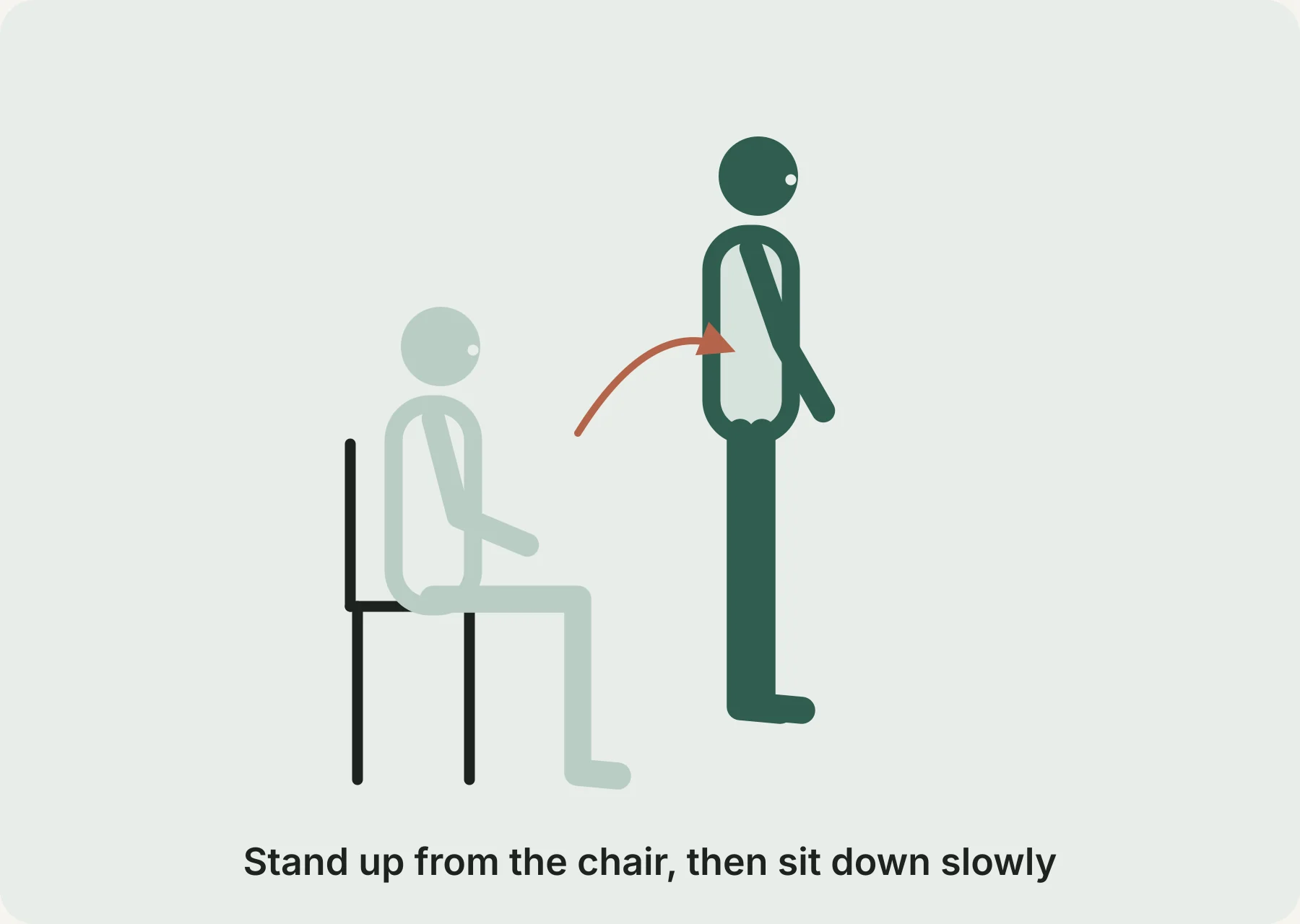
- Sit-to-stand, for your legs
- Wall press-up, for your chest and arms
- Step-ups on the bottom stair, holding the banister
- Calf raises, holding a worktop
- Bridge, for your bottom and back
- Arm curls, with tins or water bottles at first
- Band row, for your upper back and posture (see below)
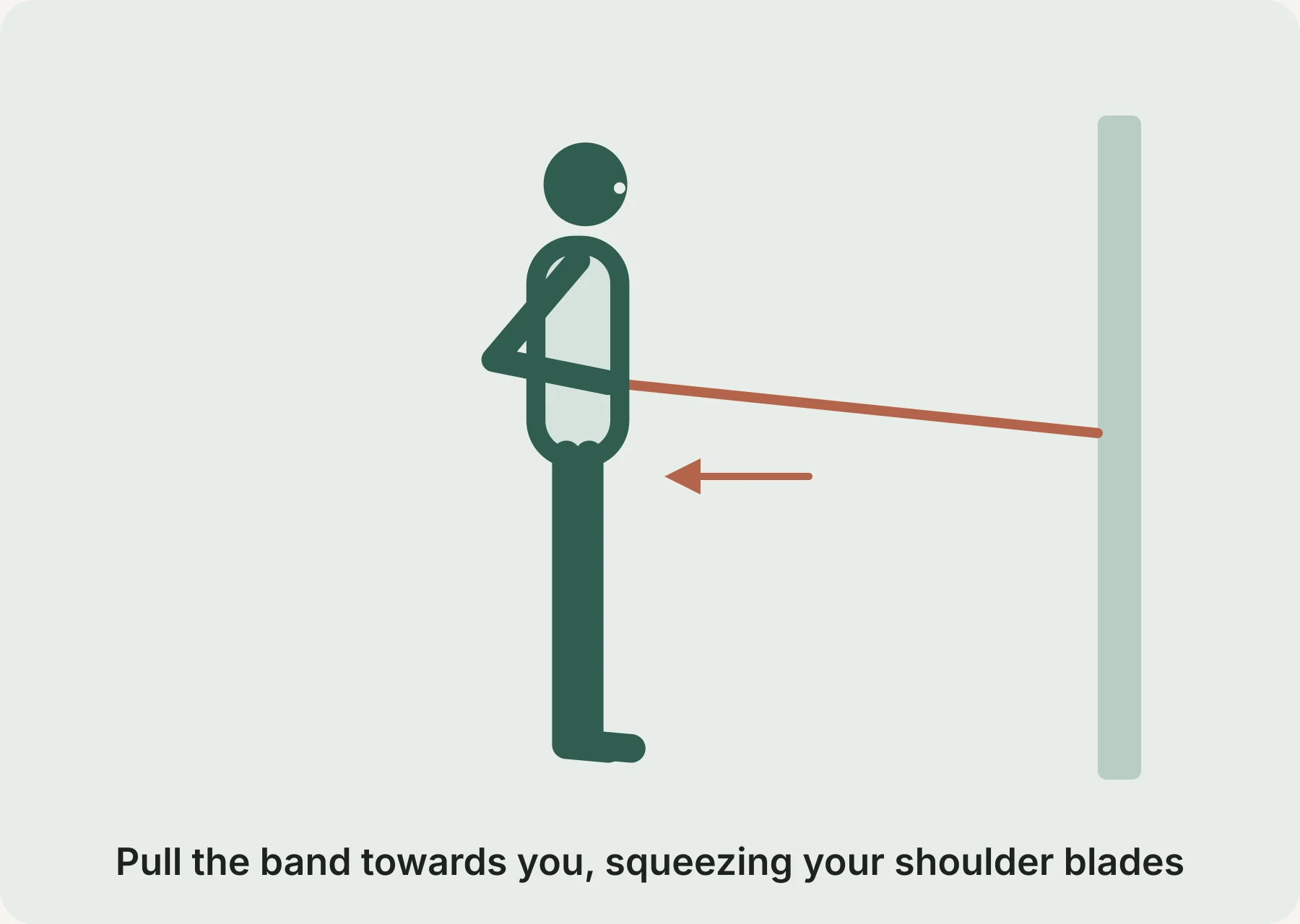
Band row: loop a resistance band round something sturdy at chest height, such as a closed door handle with the band secured. Stand facing it, holding an end in each hand. Pull your elbows back, squeezing your shoulder blades together, then return slowly.
The plan
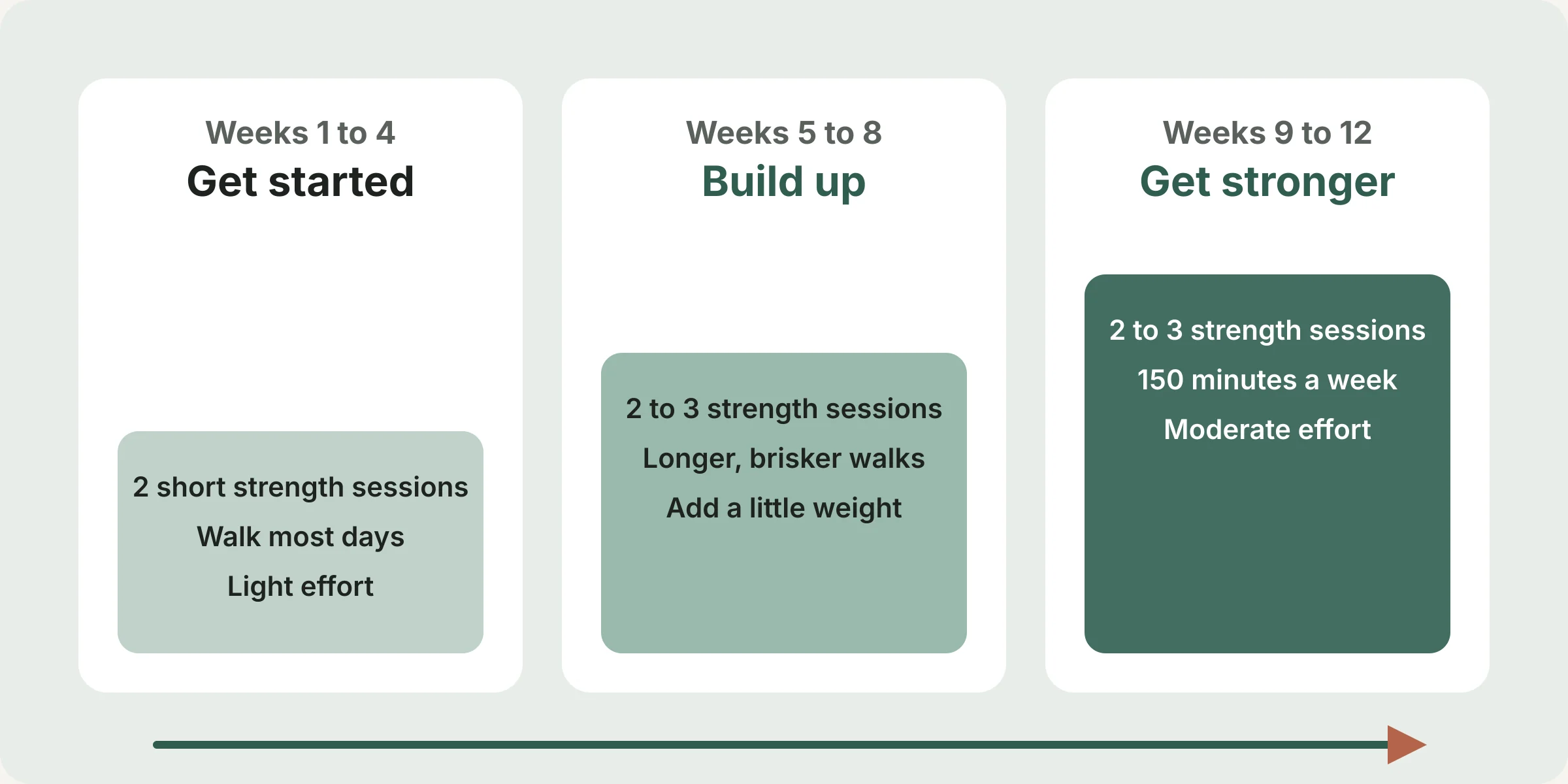
Weeks 1 to 4: get started
- Strength: 2 sessions a week, on non-consecutive days. 1 set of 8 to 10 repetitions of each exercise, with an easy effort.
- Walking: 10 to 20 minutes on most days, at a comfortable pace. Split it into shorter walks if you need to.
Weeks 5 to 8: build up
- Strength: 2 or 3 sessions a week. 2 sets of 10 to 12 repetitions, resting a minute between sets.
- Walking: 20 to 30 minutes on most days, getting a little brisker.
- Make it harder when two sets feel easy: a slower sit-to-stand, a higher step, or a slightly heavier weight or band.
Weeks 9 to 12: get stronger
- Strength: 2 or 3 sessions a week. 2 sets of 8 to 15 repetitions, with enough weight or resistance that the last few are hard work.1
- Activity: build towards 150 minutes a week of moderate activity, such as brisk walking, cycling or swimming.2
An example week (weeks 9 to 12)
| Day | Activity |
|---|---|
| Monday | Strength session, plus a 15-minute walk |
| Tuesday | 30-minute brisk walk |
| Wednesday | Strength session |
| Thursday | 30-minute brisk walk or swim |
| Friday | Rest, or a gentle walk |
| Saturday | Strength session, plus a 20-minute walk |
| Sunday | Longer walk with family or friends |
Checking your progress
At weeks 6 and 12, repeat the 30-second chair test and notice how your walks feel. Most people find they can do more, and that everyday tasks such as stairs and carrying shopping get easier. If you’re not improving, or you feel worse, talk to your team.
Stop and get advice if you have
- chest pain, a racing or irregular heartbeat, or severe breathlessness
- feeling dizzy or faint
- new or worse swelling in your arm, hand, breast or chest
- new bone pain, or pain that doesn’t settle after a day or two
- a high temperature or feeling unwell
If you’re worried, contact your team. In an emergency, call 999.
Free help to keep going
- Ask your team about NHS physiotherapy or local exercise classes for people after cancer.
- Macmillan’s free booklet Physical activity and cancer has more ideas and safety tips.3
- Breast Cancer Now’s free Moving Forward course includes advice on activity after treatment.4
A personalised option: QuestPrehab Recover
If you’d like a plan built around you, QuestPrehab Recover is a four-week personalised programme for adults in the UK who have had cancer treatment. Coaches set the right level of exercise for you and adjust it as you progress, alongside nutrition, mind and sleep. It costs £199, and you don’t pay until the team has confirmed the programme is right for you.5 Read our guide to QuestPrehab Recover, or compare UK programmes. Why we mention QuestPrehab.
Related pages
Everyone’s treatment is different, so talk to your cancer team about what is right for you.
References
- Campbell KL, Winters-Stone KM, Wiskemann J, et al. Exercise guidelines for cancer survivors: consensus statement from international multidisciplinary roundtable. Medicine & Science in Sports & Exercise. 2019;51(11):2375–2390. doi.org/10.1249/MSS.0000000000002116
- UK Chief Medical Officers. Physical activity guidelines for adults and older adults. 2019. www.gov.uk/government/publications/physical-activity-guidelines-adults-and-older-adults/physical-activity-for-adults-and-older-adults-19-and-over-text-of-the-infographic
- Macmillan Cancer Support. Physical activity and cancer (MAC12515, 6th edition). November 2023. www.macmillan.org.uk/dfsmedia/1a6f23537f7f4519bb0cf14c45b2a629/18459-10061/mac12515_physical-activity_E06_intpdf_02
- Breast Cancer Now. Moving Forward: support after breast cancer treatment. breastcancernow.org/support-for-you/moving-forward
- QuestPrehab. QuestPrehab Recover: personalised cancer rehabilitation. Accessed November 2026. questprehab.com/recover/