
The short version
- Being active is safe for most people during treatment, but some symptoms mean you should stop and get help straight away.
- If you’re having chemotherapy, call your 24-hour helpline if your temperature is over 37.5°C or below 36°C, or you suddenly feel unwell.1
- Some situations, such as low blood counts, a PICC line or bone problems, mean changing how you exercise, not necessarily stopping.2
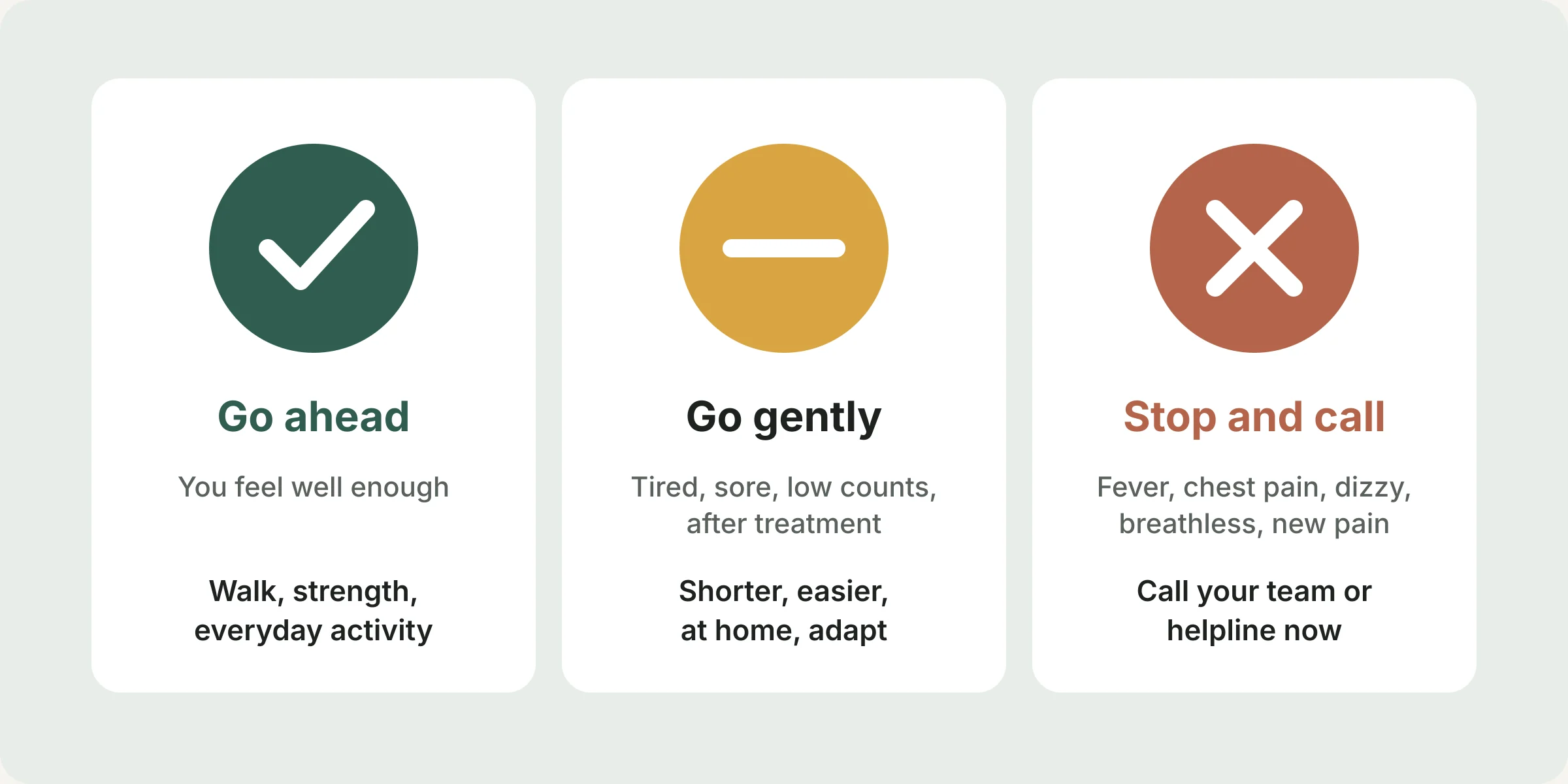
Stop and get help straight away
Stop exercising and contact a doctor or your treatment team straight away if you have:2
- chest pain, or a racing or irregular heartbeat
- difficulty breathing that doesn’t settle with rest
- dizziness or feeling faint
- feeling sick
- unusual pain in your back, bones or muscles
- a headache that won’t go away
If you're having chemotherapy
Call your chemotherapy helpline straight away, day or night, if:1
- your temperature is over 37.5°C or below 36°C
- you suddenly feel unwell, even with a normal temperature
- you feel shivery, hot or cold, or have a sore throat, cough, breathlessness, diarrhoea or need to pee often
These can be signs of a serious infection. Don’t exercise; get help.
In an emergency, such as severe chest pain or severe difficulty breathing, call 999.
Times to rest or take it easy
It’s sensible to rest, or do only very gentle movement, when you:
- feel generally unwell or feverish
- have vomiting or diarrhoea
- are very tired on the days straight after treatment
- have just had surgery: follow your team’s advice about when to restart, and start with your arm and shoulder exercises
When to adapt how you exercise
| Situation | What to do |
|---|---|
| Low white blood cells (higher infection risk) | Avoid busy places such as gyms and swimming pools. Exercise at home or outdoors.2 |
| Low platelets (bruising or bleeding) | Exercise gently and avoid high-impact or contact activities.2 |
| Anaemia | Expect to feel more tired and breathless; rest as needed.2 |
| Bone thinning or cancer in the bones | Avoid high-impact activities, contact sports and repeated forward bending. Check with your team first if cancer affects your spine or hips.2 |
| Numb feet or poor balance (neuropathy) | Choose an exercise bike or seated exercises rather than uneven walking or stairs. Check your feet for cuts and blisters.2 |
| Lymphoedema | Build up slowly, wear your compression garment if you have one, and avoid holding muscles still for long periods, such as planks.2 |
| PICC line or central line | Avoid swimming and vigorous upper-body exercise.2 |
| Radiotherapy | Avoid swimming until your skin reactions have settled.2 |
| Blood-thinning medicine | Avoid high-impact activity and contact sports.2 |
What’s normal after exercise
Some muscle soreness, stiffness and tiredness for 2 or 3 days after exercise is common, especially when you’re starting out. If you feel very sore or exhausted, do less next time.2
If in doubt, ask
If you’re not sure whether it’s safe to exercise, ask your breast care nurse, oncologist or GP. You can also ask to see a physiotherapist for advice tailored to you.
Related pages
- How much exercise is recommended?
- Exercise during chemotherapy
- When to call your team: a quick checklist
Everyone’s treatment is different, so talk to your cancer team about what is right for you.
References
- Macmillan Cancer Support. Chemotherapy (fact sheet, 2022). www.macmillan.org.uk/dfsmedia/1a6f23537f7f4519bb0cf14c45b2a629/7233-10061/mac12464-chemotherapy-final-english-for-web
- Macmillan Cancer Support. Physical activity and cancer (MAC12515, 6th edition). November 2023. www.macmillan.org.uk/dfsmedia/1a6f23537f7f4519bb0cf14c45b2a629/18459-10061/mac12515_physical-activity_E06_intpdf_02