
The short version
- For most people with cancer, about 30 minutes of moderate activity three times a week, plus strength exercises twice a week, is enough to help with fatigue, anxiety, mood and physical function.1
- The UK guideline for all adults is 150 minutes of moderate activity a week plus strength exercises on two days.2
- Any activity is better than none. Start where you are and build up gradually.
The guidelines
For everyone in the UK
The UK Chief Medical Officers recommend that adults:2
- do at least 150 minutes of moderate activity a week (you breathe faster but can still talk), or 75 minutes of vigorous activity (you can only say a few words), or a mix of both
- do strength exercises on at least two days a week
- break up long periods of sitting
For people with cancer
In 2019, an international group of experts reviewed the research on exercise and cancer. They found that, for people during and after treatment, the following helps with fatigue, anxiety, depression, physical function and quality of life:1
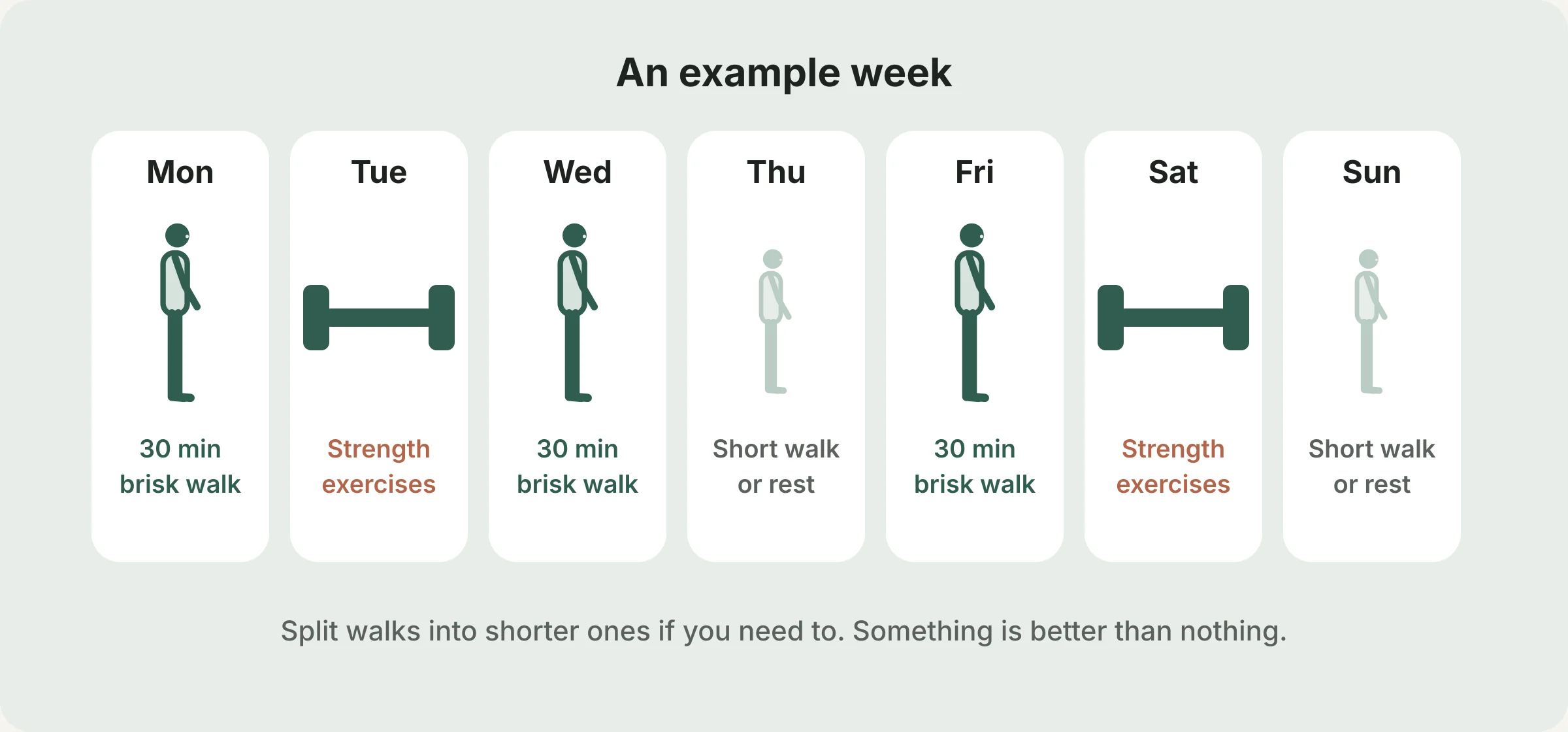
- moderate aerobic activity, such as brisk walking or cycling, for about 30 minutes, three times a week
- strength exercises at least twice a week, working the main muscle groups
They also confirmed that exercise is safe for most people and does not make lymphoedema worse.1
What counts?
| Type | Examples | How often |
|---|---|---|
| Moderate aerobic | Brisk walking, cycling, swimming, dancing, active gardening | About 30 minutes, 3 times a week |
| Strength | Sit-to-stands, wall press-ups, step-ups, light weights, resistance bands | Twice a week |
| Balance and flexibility | Tai chi, yoga, stretching, standing on one leg | Most days, especially if your balance is affected |
| Moving more in general | Short walks, housework, taking the stairs | Every day |
Use the talk test to check how hard you’re working: in moderate activity you can talk but not sing.2 See our strength exercises for illustrated instructions.
Adapting during treatment
These amounts are targets to work towards, not rules. During treatment:
- Split it up. Three 10-minute walks are as useful as one 30-minute walk.
- Go by how you feel. Do less on bad days and more on good days. Many people plan around their chemotherapy cycle.
- Keep strength going. Even short strength sessions help protect your muscles.
- Something is better than nothing. If all you manage is a few minutes, that still counts.
If you’re starting from scratch
- Begin with 5 to 10 minutes of gentle walking each day.
- Add a few minutes each week.
- After a week or two, add sit-to-stands twice a week.
- Build towards 30 minutes, three times a week, over several weeks.
Check first if…
Talk to your team before increasing your activity if you have heart or lung problems, bone pain or cancer that has spread to the bones, dizziness, numbness in your feet, or you’ve recently had surgery. Read when to rest: exercise safety and red flags.
Prefer a guided plan?
A personalised digital programme can set the right amount of activity for you and increase it as you get stronger, with coaches to check your progress. See how digital rehabilitation works.
Free support
- Macmillan Move More: free activity sessions in many areas
- Penny Brohn UK: free online strength and stamina sessions
- Cancer rehab personal trainers: qualified one-to-one support (self-pay)
Related pages
Everyone’s treatment is different, so talk to your cancer team about what is right for you.
References
- Campbell KL, Winters-Stone KM, Wiskemann J, et al. Exercise guidelines for cancer survivors: consensus statement from international multidisciplinary roundtable. Medicine & Science in Sports & Exercise. 2019;51(11):2375–2390. doi.org/10.1249/MSS.0000000000002116
- UK Chief Medical Officers. Physical activity guidelines for adults and older adults. 2019. www.gov.uk/government/publications/physical-activity-guidelines-adults-and-older-adults/physical-activity-for-adults-and-older-adults-19-and-over-text-of-the-infographic