
The short version
- Aromatase inhibitors and treatment that causes an early menopause can thin your bones over time, raising the risk of osteoporosis.1, 2
- UK guidance recommends a bone density (DEXA) scan when you start an aromatase inhibitor, with calcium, vitamin D or bone-protecting medicines if needed.2
- Strength training, impact exercise and balance work help keep your bones and muscles strong.3
Why bones can be affected
Oestrogen helps keep bones strong. Aromatase inhibitors (anastrozole, letrozole and exemestane) lower oestrogen levels after the menopause, and some treatments bring on an early menopause. Over time, this can make bones thinner and more likely to break.1
Checking your bones
UK expert guidance, used by NICE, recommends that people starting an aromatase inhibitor after the menopause have:2
- a DEXA scan (a quick, painless bone density scan) within six months of starting
- calcium and vitamin D supplements if their bone density is lower than normal
- bone-protecting medicines (bisphosphonates) if their risk of fracture is high
- a repeat scan after about two years if their bones were already thinner than normal
If you haven’t been offered a bone scan, it’s worth asking your team or GP.
Exercise for strong bones
The UK consensus statement on exercise for bone health, Strong, Steady and Straight, recommends:3
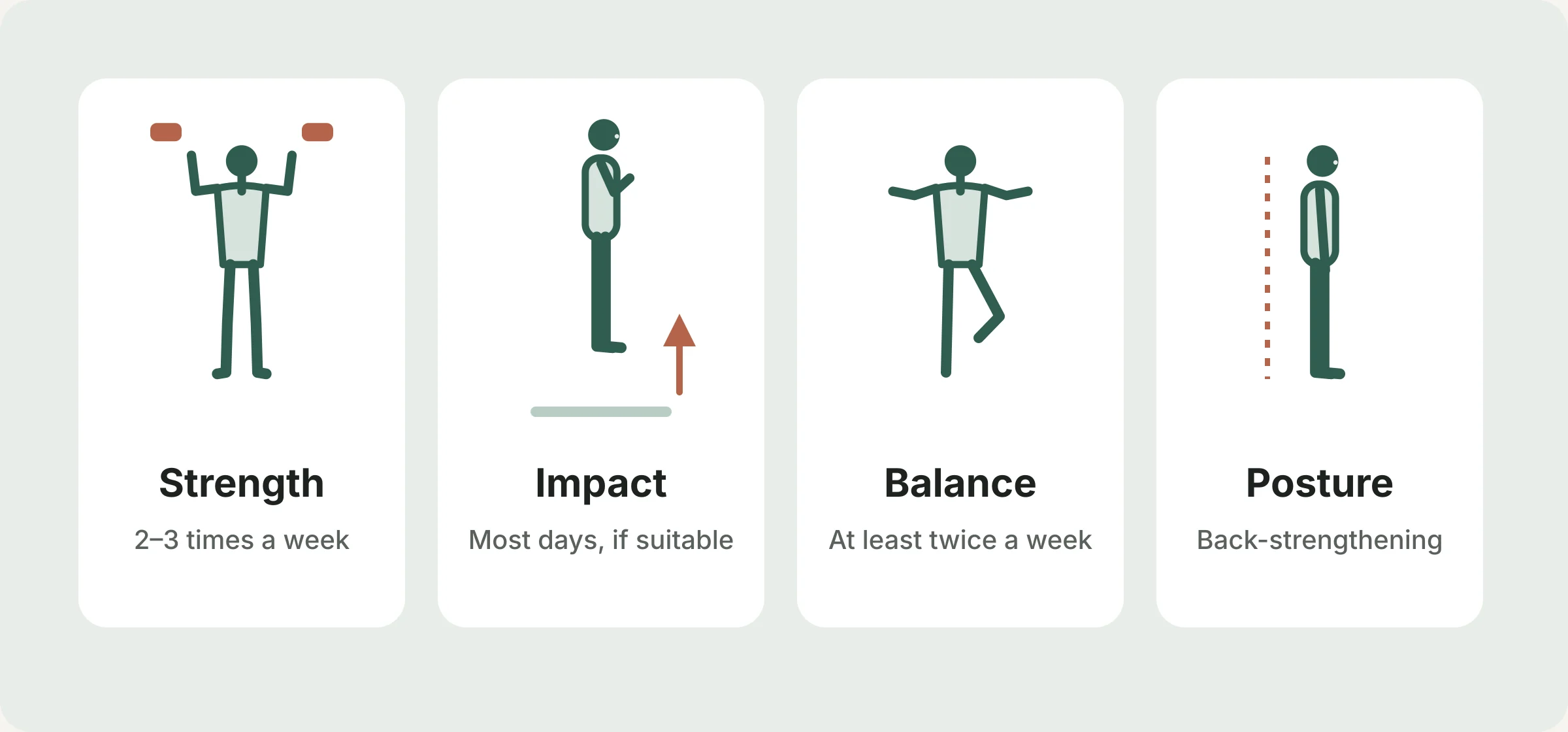
| Type | What to do | How often |
|---|---|---|
| Strength | Exercises using weights, bands or your own body weight, working up to about 8 to 12 repetitions that feel hard by the end | 2 to 3 days a week |
| Impact | Brisk walking, stair climbing, or, if suitable, jogging, hopping or small jumps | Most days |
| Balance | Standing on one leg, heel-to-toe walking, tai chi | At least twice a week |
| Posture | Exercises that strengthen your back muscles | At least twice a week |
If you already have osteoporosis or have had a fracture, keep impact to brisk walking level, and ask for advice from a physiotherapist before starting. Avoid repeated or loaded forward bending, such as sit-ups.3 If cancer has spread to your bones, check with your team before exercising.4
Other ways to look after your bones
- Calcium: from dairy foods, fortified plant milks, tinned fish with bones, tofu and green leafy vegetables.
- Vitamin D: from sunlight on your skin in the summer months, and supplements if advised.
- Avoid smoking and keep alcohol within the UK low-risk guidelines.
- Keep a healthy weight. Being underweight is a risk factor for weak bones.
Prefer a guided plan?
A personalised programme can build strength, impact and balance work into your week safely, increasing it as you get stronger. See how digital rehabilitation works.
Related pages
Everyone’s treatment is different, so talk to your cancer team about what is right for you.
References
- Breast Cancer Now. Hormone (endocrine) therapy. breastcancernow.org/about-breast-cancer/treatment/hormone-endocrine-therapy
- Husnoo N, Goonoo MS, Abbas S. Practical management of aromatase inhibitor-induced bone loss in breast cancer patients. British Journal of Medical Practitioners. 2016;9(4):a931 (summarising the UK expert group guidance, Reid et al. 2008). www.bjmp.org/content/practical-management-aromatase-inhibitor-induced-bone-loss-breast-cancer-patients
- Brooke-Wavell K, Skelton DA, Barker KL, et al. Strong, steady and straight: UK consensus statement on physical activity and exercise for osteoporosis. British Journal of Sports Medicine. 2022;56(15):837. bjsm.bmj.com/content/56/15/837
- Macmillan Cancer Support. Physical activity and cancer (MAC12515, 6th edition). November 2023. www.macmillan.org.uk/dfsmedia/1a6f23537f7f4519bb0cf14c45b2a629/18459-10061/mac12515_physical-activity_E06_intpdf_02