
The short version
- Being open and honest, in words that suit their age, usually helps children cope better than trying to protect them from the news.1
- Children often notice that something is wrong. Telling them yourself means they don’t hear it by accident or imagine something worse.
- There are books, guides and charities to help, including Macmillan’s free guide and Breast Cancer Now’s list of resources.2
Before you talk
- Think about what to say, and perhaps practise with your partner, a friend or your breast care nurse.
- Choose a quiet time when you won’t be rushed.
- Use the word “cancer”, so they don’t hear it elsewhere and feel confused.
- Tell them what will happen: hospital visits, tiredness, hair loss, and who will look after them.
By age
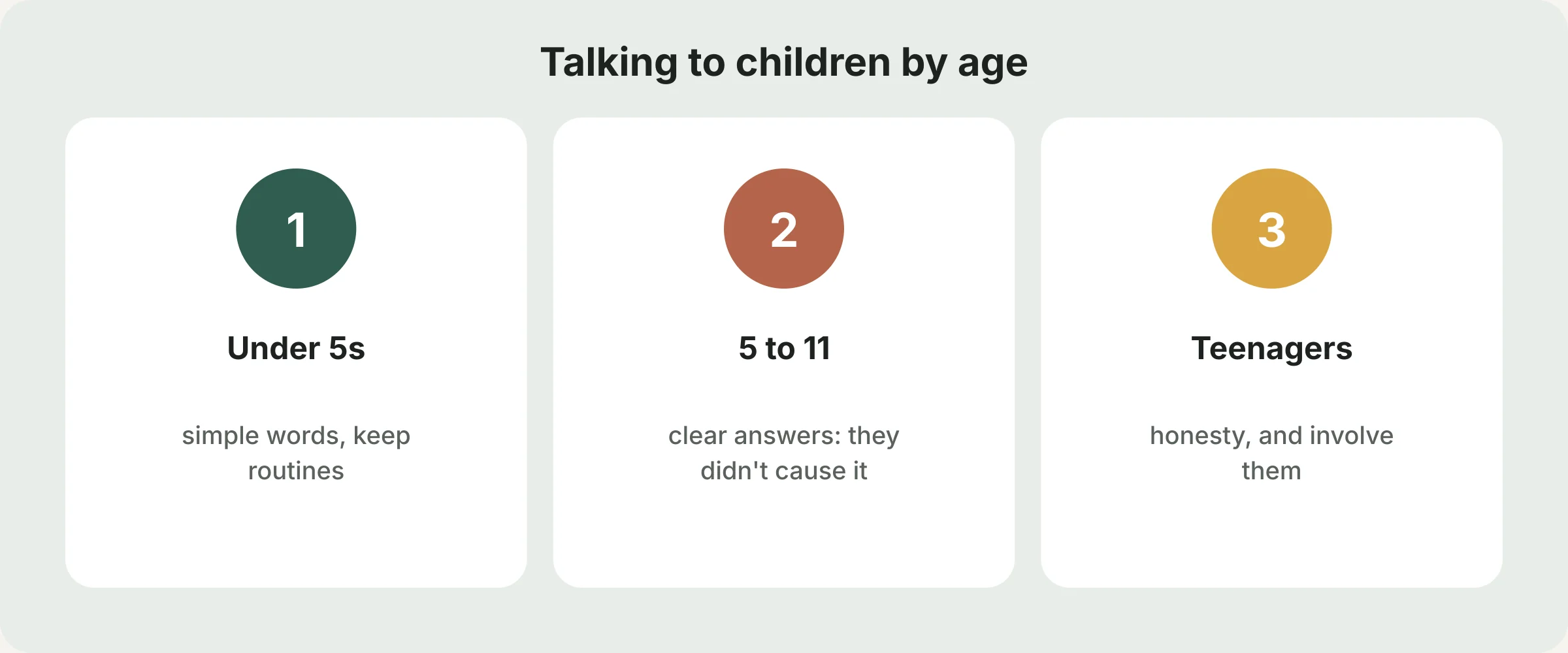
- Under 5s: keep it simple and concrete. Keep routines as normal as possible. Reassure them that they’ll be looked after.
- 5 to 11: explain in simple, clear words. They may worry that they caused it, or that they can catch it. Reassure them that they didn’t, and they can’t.
- Teenagers: be honest, and involve them. They may want information, or need space. Let them know it’s okay to carry on with their own lives.
Things that help
- Let them ask questions, and answer honestly. It’s fine to say “I don’t know”.
- Keep routines going as much as possible.
- Tell school or nursery, so they can support your child.1
- Show your feelings. It’s okay for children to see you’re sad sometimes.
- Give them a job, such as helping with something at home, if they’d like one.
- Keep talking, as their questions will change over time.
Books and resources
Breast Cancer Now has a list of books and organisations for talking with children, including:2
- Macmillan’s free guide, Talking to children and teenagers when an adult has cancer
- picture books for younger children, such as Mum’s Purple Scarf and Nurse Ted
- My Parent Has Cancer and It Really Sucks, for teenagers
- The Osborne Trust, which supports children and young people whose parent has cancer
- Hope Support Services, for young people aged 5 to 25 when a loved one is seriously ill
- Fruitfly Collective, with resources from experts in cancer care and parenting
Getting support
- Ask your breast care nurse, who may be able to help you plan what to say.
- Maggie’s supports family members, including children.3
- Breast Cancer Now helpline: free on 0808 800 6000.4
Related pages
Everyone’s treatment is different, so talk to your cancer team about what is right for you.
References
- Breast Cancer Now. Breast cancer in younger women (BCC66). breastcancernow.org/media-assets/1wwkarmz/bcc66-breast-cancer-in-younger-women-web-pdf.pdf
- Breast Cancer Now. Resources for talking with children about breast cancer. breastcancernow.org/about-breast-cancer/primary-breast-cancer/talking-with-children-about-breast-cancer/resources-for-talking-with-children-about-breast-cancer
- Maggie’s. Facts and statistics 2025. maggies.org/media/filer_public/b0/75/b0759449-fcd5-4331-a14f-6b822f8bfed2/maggies_facts_stats_2025.pdf
- Breast Cancer Now. Call our helpline. breastcancernow.org/support-for-you/call-our-helpline