
The short version
- Nearly 6,000 women aged 45 or younger are diagnosed with breast cancer in the UK each year.1
- Younger women often face particular issues, such as fertility, early menopause, contraception, young children, work and genetics.1
- There’s dedicated support for younger women, including free events and one-to-one peer support from Breast Cancer Now.1
Things to think about early
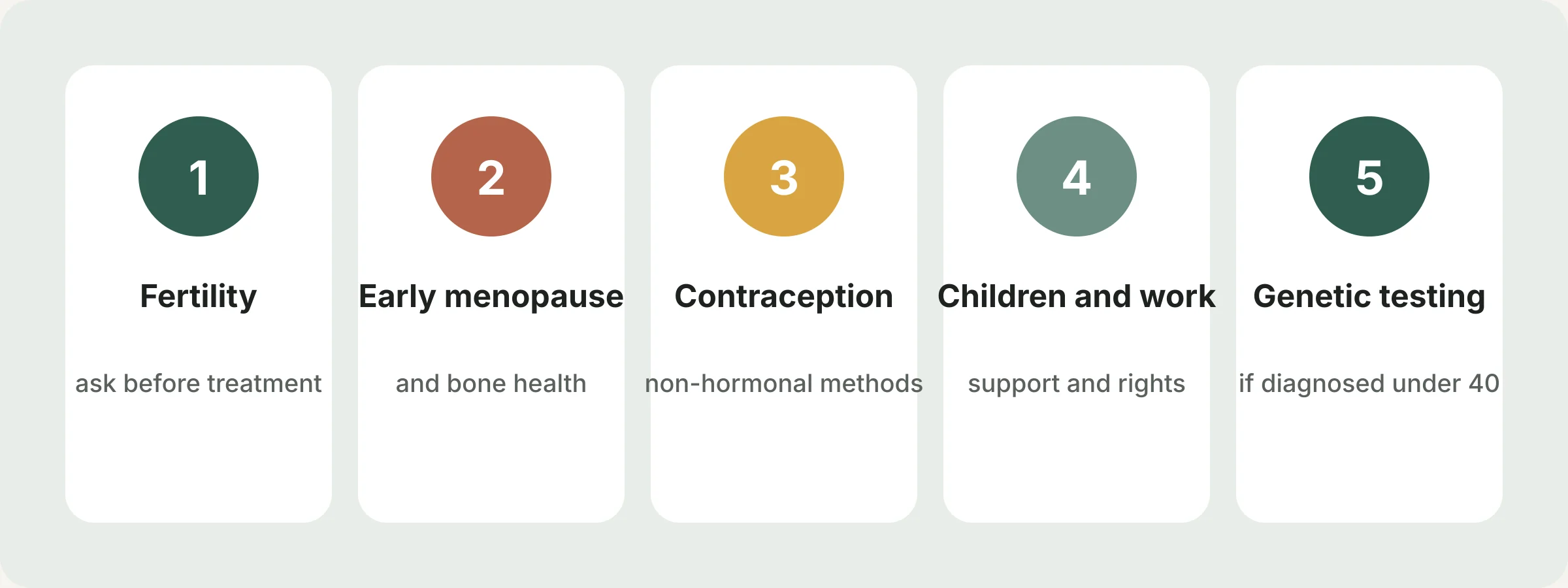
Fertility
Chemotherapy can affect your ovaries and fertility. If you might want children, ask for a referral to a fertility specialist before treatment starts.1 See fertility preservation before treatment.
Early menopause
Chemotherapy can bring on menopause earlier, and treatments such as ovarian suppression stop the ovaries working, temporarily or permanently. This can affect your bones, so a bone density scan may be recommended.1 See menopause symptoms caused by treatment.
Contraception and pregnancy
- Non-hormonal contraception, such as condoms or a copper coil, is usually recommended. The contraceptive pill isn’t usually used after a breast cancer diagnosis.1
- You may still be able to get pregnant even if your periods stop, so keep using contraception until your team says otherwise.1
- Pregnancy after treatment: there’s currently no evidence that it increases the risk of the cancer coming back. Many specialists advise waiting at least two years, and you’ll need to avoid pregnancy during and for a while after some treatments.1 Talk to your team.
Genetic testing
About 5% of women with breast cancer have an inherited gene change, most often in BRCA1 or BRCA2. Genetic testing is offered to women diagnosed before 40, and to women with triple negative breast cancer, whatever their family history.1 See BRCA and inherited breast cancer.
Children and work
Staying active
Being active helps you get through treatment and recover, and is especially important for bone health if you have an early menopause or ovarian suppression.2, 3 See preparing for treatment and getting your strength back.
Support for younger women
- Younger Women Together: a free two-day event from Breast Cancer Now for women aged 45 or younger diagnosed with primary breast cancer in the past three years.1
- Someone Like Me: one-to-one support from Breast Cancer Now, by phone or email, with someone who’s had a similar experience.1
- Breast Cancer Now helpline: free on 0808 800 6000.1
- Shine Cancer Support, for adults in their 20s, 30s and 40s.
- Future Dreams, with support in London and online.
Related pages
Everyone’s treatment is different, so talk to your cancer team about what is right for you.
References
- Breast Cancer Now. Breast cancer in younger women (BCC66). breastcancernow.org/media-assets/1wwkarmz/bcc66-breast-cancer-in-younger-women-web-pdf.pdf
- Campbell KL, Winters-Stone KM, Wiskemann J, et al. Exercise guidelines for cancer survivors: consensus statement from international multidisciplinary roundtable. Medicine & Science in Sports & Exercise. 2019;51(11):2375–2390. doi.org/10.1249/MSS.0000000000002116
- Brooke-Wavell K, Skelton DA, Barker KL, et al. Strong, steady and straight: UK consensus statement on physical activity and exercise for osteoporosis. British Journal of Sports Medicine. 2022;56(15):837. bjsm.bmj.com/content/56/15/837