
The short version
- Palliative care helps you live as well as possible by managing pain and other symptoms, and supporting your emotional, practical and spiritual needs.1
- It’s not only for the end of life. You can have palliative care alongside treatment such as chemotherapy or radiotherapy.1
- It can be provided at home, in hospital, in a hospice or in a care home.1
What palliative care is
Palliative care supports people with an illness that can’t be cured. It aims to treat or manage pain and other physical symptoms, and also helps with psychological, social and spiritual needs.1 It looks after the people close to you too.
Many people worry that being referred to palliative care means treatment is ending. It doesn’t. You can receive palliative care alongside other treatments, at any stage of your illness.1
Who provides it
- General palliative care: from the professionals you already see, such as your GP, community nurses and hospital team.1
- Specialist palliative care: from palliative care doctors and nurses, in hospitals, in the community and in hospices, for more complex needs.1
- Hospices offer much more than end-of-life care, including day services, therapies, and support for families.
How it can help
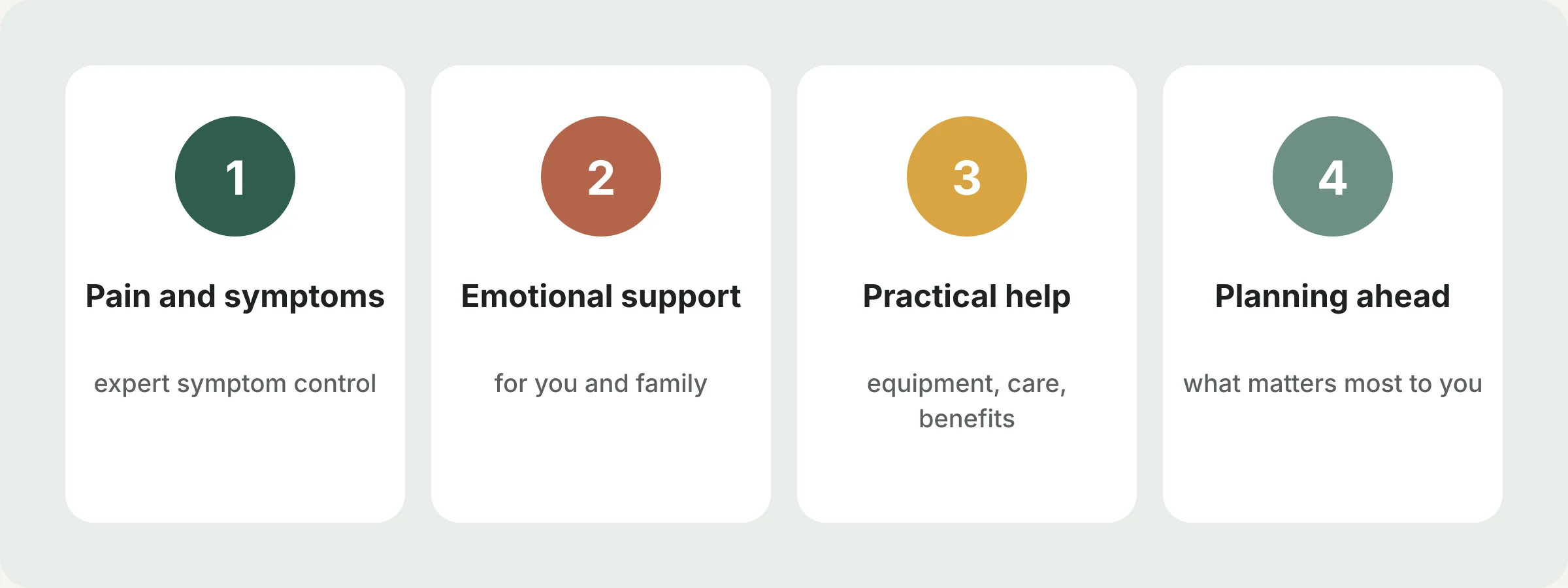
- Symptom control: pain, breathlessness, sickness, fatigue
- Emotional support: for worry, low mood and difficult conversations
- Practical help: equipment at home, care and benefits
- Planning ahead: talking about what matters most to you, and recording your wishes
- Support for family and carers
How to get it
Ask your oncologist, clinical nurse specialist or GP to refer you to the palliative care team, or ask about your local hospice. You don’t have to wait until things get worse.
Living well
Staying as active as you can, eating what you enjoy, and spending time on things that matter to you are all part of living well. See staying active and eating well.
Support
- Marie Curie support line: 0800 090 2309.2
- Breast Cancer Now helpline: free on 0808 800 6000.3
- Macmillan Support Line: free on 0808 808 00 00.
Related pages
Everyone’s treatment is different, so talk to your cancer team about what is right for you.
References
- Marie Curie. What is palliative and end of life care? www.mariecurie.org.uk/globalassets/media/documents/policy/what-is-palliative-and-end-of-life-care.pdf
- NHS 111 Wales. Marie Curie (local service listing). 111.wales.nhs.uk/localservices/viewlocalservice.aspx?id=801
- Breast Cancer Now. Support for you: secondary breast cancer (leaflet). breastcancernow.org/media-assets/4xibp3mc/support_for_you_sbc_leaflet.pdf