
The short version
- Being active can help you feel stronger, manage fatigue, and keep doing the things that matter to you.1
- Bone metastases don’t automatically mean you can’t exercise. International experts say exercise can be done safely with the right assessment and guidance.2
- Talk to your team first, especially if the cancer is in your bones, and ask about a physiotherapist or exercise professional with cancer experience.2
Why it can help
Exercise during cancer treatment improves fatigue, anxiety, depression, physical function and quality of life.1 For many people with secondary breast cancer, staying active also means staying independent: being able to walk, climb stairs, and look after yourself.
If the cancer is in your bones
Exercise has often been avoided in people with bone metastases because of worries about fractures. An international expert group has set out how exercise can be done safely:2
- your risk depends on where the cancer is in your bones, your treatment, and your general health
- exercise should be planned and supervised by qualified professionals with cancer experience
- programmes should focus on good posture, controlled movements and good technique
- the risks and benefits should be discussed together by you, your medical team and your exercise professional
Ask your team which movements, if any, you should avoid, for example heavy lifting, twisting or high-impact activity.
Ideas for staying active
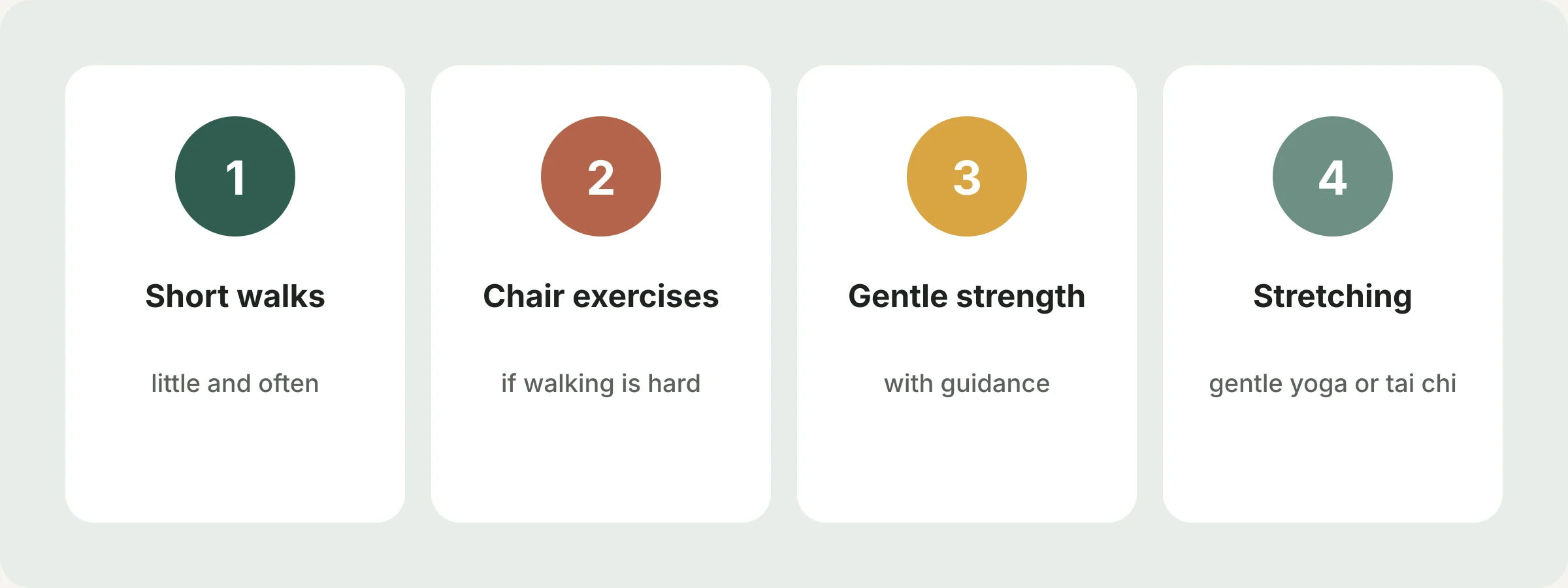
- Short walks, little and often
- Chair-based exercises, if walking is difficult
- Gentle strength exercises, with guidance
- Stretching, gentle yoga or tai chi
- Everyday activity, such as gardening or household tasks, at your own pace
Plan activity for times when you have most energy, and rest when you need to. See energy pacing.
Stop and contact your team if you have
- new or worsening bone pain, especially in your back, or pain that’s worse at night
- numbness, weakness or tingling in your legs, or problems controlling your bladder or bowel. Contact your team or acute oncology helpline urgently, as this can be a sign of pressure on the spinal cord.
- breathlessness, chest pain, or feeling faint
Getting help
- Ask your team about NHS physiotherapy or occupational therapy.
- Ask about exercise professionals with cancer experience. See find a cancer rehab personal trainer.
- Breast Cancer Now’s Living with Secondary Breast Cancer groups include topics such as exercise.3
Related pages
Everyone’s treatment is different, so talk to your cancer team about what is right for you.
References
- Campbell KL, Winters-Stone KM, Wiskemann J, et al. Exercise guidelines for cancer survivors: consensus statement from international multidisciplinary roundtable. Medicine & Science in Sports & Exercise. 2019;51(11):2375–2390. doi.org/10.1249/MSS.0000000000002116
- Campbell KL, Cormie P, Weller S, et al. Exercise recommendation for people with bone metastases: expert consensus for health care providers and exercise professionals. JCO Oncology Practice. 2022;18(5). napier-repository.worktribe.com/output/2839264/exercise-recommendation-for-people-with-bone-metastases-expert-consensus-for-health-care-providers-and-exercise-professionals
- Breast Cancer Now. Support for you: secondary breast cancer (leaflet). breastcancernow.org/media-assets/4xibp3mc/support_for_you_sbc_leaflet.pdf