
The short version
- Follow your team’s instructions for wound care in the first couple of weeks, and watch for signs of infection.
- Once your wound has fully healed (usually from about two weeks, with no scabs or stitches), scar massage can help your scar become flatter, softer and more comfortable.1
- Scars keep changing for 12 to 18 months, so it’s worth keeping going.1
Looking after your wound
Your nurse will tell you how to care for your wound and dressings, when you can shower, and when any stitches or drains will be removed. Wounds usually take about six weeks to heal fully after a mastectomy.2
Contact your team if you notice…
Scar massage
Massaging your scar once it has healed can help stop it sticking to the tissue underneath, and can make it flatter, softer and less sensitive.
When to start
You can usually start about two weeks after surgery, once the scar has healed. Don’t massage if there are still stitches or scabs. If you’re having radiotherapy, moisturise daily and check with your breast care nurse before massaging the treated area.1
How to do it
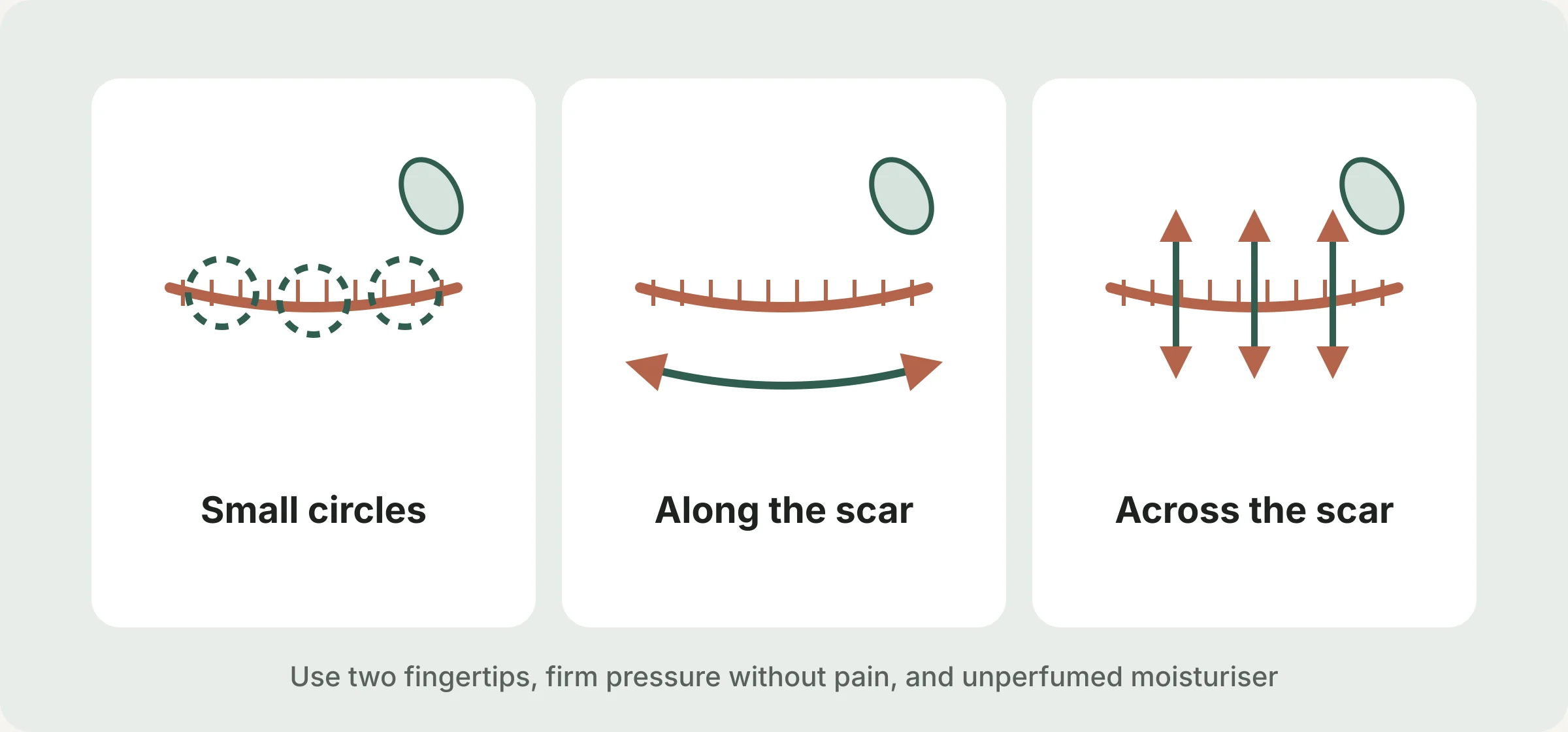
- Use a little unperfumed moisturiser.
- Place the tips of two or more fingers on the scar.
- Press firmly, enough to make the skin go pale, but it shouldn’t hurt.
- Move your fingers slowly in one of three ways: small circles along the scar, up and down along its length, or side to side across it.
- Cover the whole scar and the skin around it.1
How often
Start with 2 to 3 minutes, 2 to 3 times a day. After a few days, build up to 5 to 10 minutes, 2 to 3 times a day.1
How long to keep going
Carry on until your scar is flat, moves freely and feels comfortable. Scars keep changing for 12 to 18 months, and it can take several months to see a big difference. Ask your breast care nurse for advice if things aren’t improving.1
Stop and contact your GP or team if the scar becomes red, bleeds, feels hot or more painful than usual.1
Other tips
- Protect your scar from the sun with clothing or high-factor sunscreen, as new scars can darken.
- Keep moving your arm. Your arm and shoulder exercises help stop tightness around the scar.
- Talk to your team if your scar is raised, very itchy or painful, or affects how you feel about your body. Specialist treatments may help.
Related pages
Everyone’s treatment is different, so talk to your cancer team about what is right for you.
References
- Royal Berkshire NHS Foundation Trust Breast Unit. Scar massage following breast cancer surgery. March 2025. royalberkshire.nhs.uk/media/chhj4rts/scar-massage-following-breast-cancer-surgery_mar25.pdf
- NHS. Mastectomy. www.nhs.uk/tests-and-treatments/mastectomy/
- Breast Cancer Now. Exercises after breast cancer surgery (BCC6). breastcancernow.org/media-assets/yjajew1j/bcc6-exercises-after-breast-cancer-surgery-web.pdf