
The short version
- Many people go home the same day or after 1 or 2 days. Most return to their usual activities in around 3 weeks, and wounds take about 6 weeks to heal fully.1
- In the weeks before, get as active as you can, eat well, stop smoking and learn your arm and shoulder exercises.2
- Plan practical help at home for the first couple of weeks, when you’ll need to avoid heavy lifting.1
What happens
A mastectomy is an operation to remove the breast. It’s often done with surgery to the lymph nodes in the armpit, and sometimes with breast reconstruction at the same time. Your surgical team will explain what’s planned for you.
Before the operation you’ll usually have a pre-operative assessment a few days or weeks beforehand, to check your general health. This may include blood tests and a heart tracing (ECG).1
After surgery, you may have one or more thin tubes called drains to remove fluid from the wound. These are temporary and are usually removed within a few days or weeks. Some people go home with a drain in place.1
If you have reconstruction at the same time, you’ll usually stay in hospital for a few days, and recovery takes longer.1
Getting your body ready
Move more
Being as active as you can in the weeks before surgery helps you go into the operation stronger. Aim to build up gradually towards about 30 minutes of moderate activity three times a week, plus strength exercises.3 See moving more before surgery and our simple prehab plan.
Learn your arm and shoulder exercises now
Breast Cancer Now suggests starting your arm and shoulder exercises before surgery, so you know your normal range of movement and the exercises feel familiar.2 After surgery, you’ll usually start gentle exercises the day after your operation. See arm and shoulder exercises.
Eat well
Include protein at every meal to help with healing, and tell your team if you’ve lost weight without trying. See eating well before treatment.
Stop smoking
Stopping smoking a few weeks before surgery helps your wounds heal and lowers the risk of complications.1 Ask your GP or pharmacist about free NHS stop smoking support.
Getting your home ready
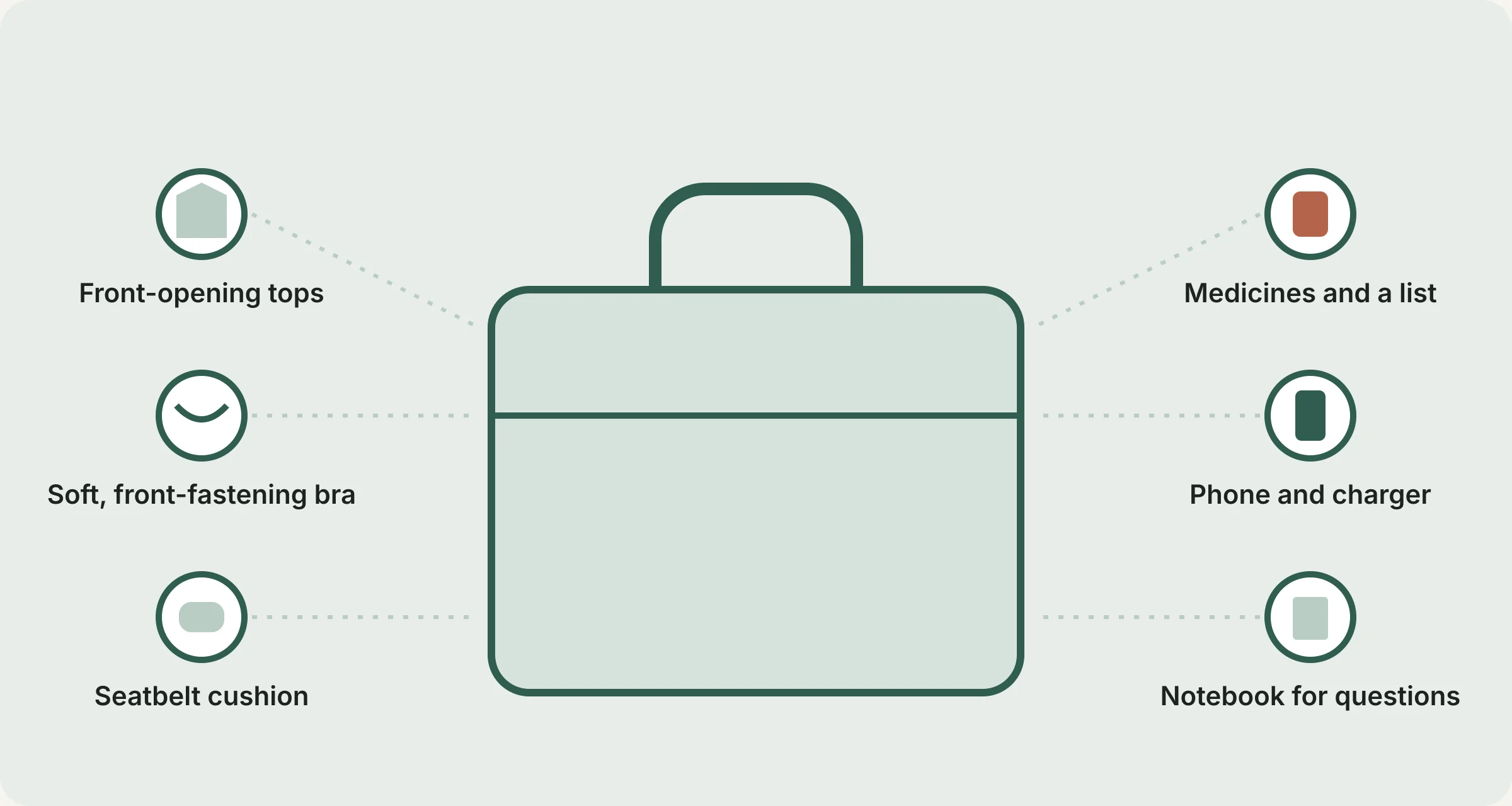
What to pack
- front-opening, loose tops and a soft, front-fastening bra or crop top (your nurse may advise on this)
- a small cushion to put between the seatbelt and your chest on the way home
- your medicines, and a list of everything you take1
- phone, charger and something to pass the time
- a notebook for questions and instructions
Before you go in
- Arrange help with shopping, cleaning, lifting and childcare for the first couple of weeks. You’ll need to avoid heavy lifting and strenuous activities for 2 to 3 weeks.1
- Put everyday things at waist height, so you don’t have to reach up high or bend down low.
- Prepare some meals for the freezer.
- Plan transport home. You shouldn’t drive until your wounds have healed and you can comfortably wear a seatbelt.1
- Talk to your employer about time off and a phased return.
Looking after your mind
It’s natural to feel anxious about surgery and about how your body will look and feel afterwards. Talk to your breast care nurse about your worries, including questions about reconstruction, prostheses and bras. Breast Cancer Now’s helpline (0808 800 6000) can also help. See managing anxiety while you wait.
After surgery: when to get help
Get help if you have…
- sudden pain or swelling, bleeding from the wound, or sudden loss of feeling in your arm: call your breast care team or NHS 111.1
- severe difficulty breathing, chest or upper back pain, a very fast heartbeat, or someone passes out: call 999 or go to A&E. These can be signs of a blood clot in the lungs.1
- signs of infection: redness, heat, discharge from the wound, or a high temperature. Contact your team.
Prefer a guided plan?
A personalised digital prehab programme plans your preparation around your surgery date, including arm and shoulder work, and continues into recovery afterwards. See how digital prehab works.
Related pages
- Preparing for breast reconstruction
- Wound and scar care after breast surgery
- Reducing your risk of lymphoedema
Everyone’s treatment is different, so talk to your cancer team about what is right for you.
References
- NHS. Mastectomy. www.nhs.uk/tests-and-treatments/mastectomy/
- Breast Cancer Now. Exercises after breast cancer surgery (BCC6). breastcancernow.org/media-assets/yjajew1j/bcc6-exercises-after-breast-cancer-surgery-web.pdf
- Campbell KL, Winters-Stone KM, Wiskemann J, et al. Exercise guidelines for cancer survivors: consensus statement from international multidisciplinary roundtable. Medicine & Science in Sports & Exercise. 2019;51(11):2375–2390. doi.org/10.1249/MSS.0000000000002116