
The short version
- Digital prehabilitation is a personalised programme you follow at home, using an app, video calls or phone calls, to get stronger before cancer treatment.
- The best programmes combine exercise, nutrition, mental wellbeing and sleep, are designed by clinicians, and adjust as you progress.
- You can get digital prehab through some NHS hospitals, or refer yourself to a provider if it isn’t offered locally.
What is digital prehab?
Prehabilitation means preparing your body and mind for cancer treatment. Traditionally this meant hospital classes or appointments with physiotherapists and dietitians. Digital prehab delivers the same kind of support remotely, so you can take part from home, at times that suit you, without extra trips to hospital.
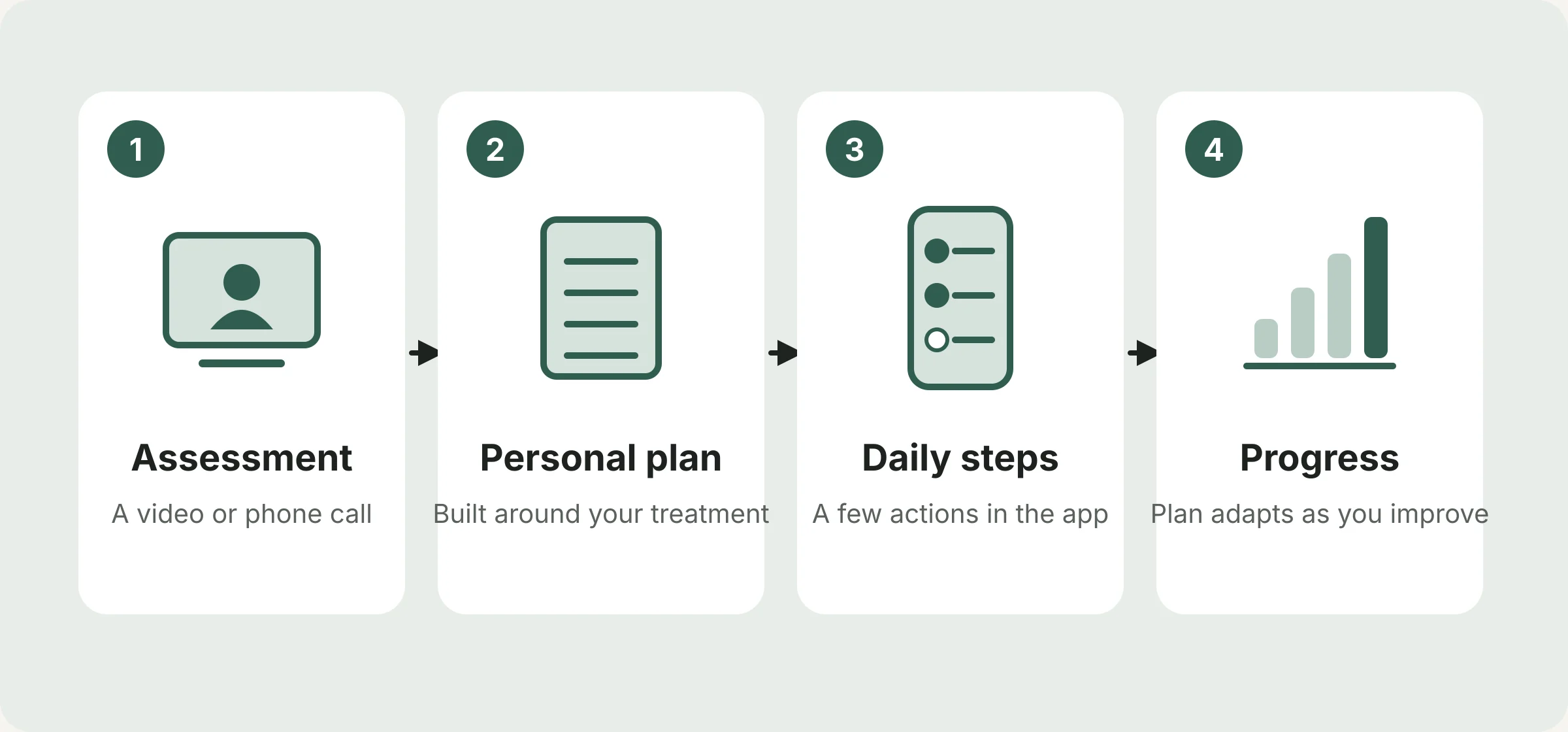
Most digital programmes include:
- an assessment of your fitness, nutrition, mood and any health conditions, usually by video or phone
- a personalised plan built around your treatment date and what you can do now
- daily steps in an app: short exercise sessions, food goals, breathing or relaxation practice
- progress tracking, so your plan gets harder as you get stronger
- check-ins with a coach or clinician, who can answer questions and adjust the plan
Does it work?
The evidence for prehabilitation in general is growing, and UK guidance recommends it for people with cancer.1 Evidence for digital delivery is newer, but UK studies are encouraging:
- A telehealth-delivered, home-based prehab programme for people with cancer, including breast cancer, enrolled 76% of people referred. Participants reported significant improvements in self-rated health and fatigue after the programme.2
- A UK study looked specifically at prehabilitation in the breast cancer pathway and found it was feasible to deliver alongside breast cancer treatment.3
- A cost analysis of a digital multimodal prehab service found an average cost of around £460 per patient, roughly a tenth of the average hospital stay costs for cancer surgery in the same group.4
These studies were run by the team behind QuestPrehab, one of the digital programmes on this page. They did not have a control group, so they show that digital prehab is practical and acceptable, rather than proving exactly how much it improves outcomes. Larger trials are under way across the field.
More broadly, there is strong evidence that exercise during and after cancer treatment improves fatigue, anxiety, low mood, physical function and quality of life.5 Digital programmes are a way of helping people actually do it.
Why people choose digital prehab
- No travel. You don’t have to get to a gym or hospital class, which matters when you have lots of appointments already.
- Fits around your life. Sessions are short and you choose when to do them.
- Personal. A good programme is built around your treatment, fitness and goals, not a one-size-fits-all leaflet.
- Joined up. Movement, food, mood and sleep are planned together.
- Someone in your corner. Regular check-ins help you keep going on difficult days.
Digital prehab doesn’t suit everyone. If you don’t have a smartphone or tablet, or you would rather be with other people, ask about face-to-face or group options too.
How to get digital prehab in the UK
Through the NHS
A growing number of NHS trusts and cancer alliances offer digital prehabilitation. Availability is still patchy, so ask your breast care nurse directly: “Is there a prehabilitation programme I can join before my treatment, and can I do it from home?”
England’s National Cancer Plan commits to a digital-first prehabilitation offer for all cancer patients, so more areas are expected to offer it over the next few years.6
Self-referral, if it isn’t offered locally
If your hospital doesn’t offer prehab, or you don’t want to wait, you can refer yourself to some providers:
| Programme | How to access | What it covers | Cost |
|---|---|---|---|
| QuestPrehab | Through some NHS hospitals, or self-referral | Exercise, nutrition, mind and sleep, with coach support | Self-pay: price on application |
| Reframe Cancer (Alvie) | Self-pay through Reframe Cancer | Digital prehabilitation with coaching | Price on application |
| Perci Health | Through employers only | Virtual clinic with physiotherapy, nutrition and psychology | Funded by employer |
See our full comparison of UK digital prehab and rehab programmes for the details we check, including evidence, regulation and NHS use.
A personalised option: QuestPrehab
QuestPrehab’s clinically led digital prehab programmes are used by NHS hospitals to help patients prepare for cancer treatment and surgery. The company states that it is registered with the MHRA and that its programme with West Hertfordshire Teaching Hospitals won Surgical Care Safety Initiative of the Year at the 2026 HSJ Patient Safety Awards.7 If your hospital doesn’t offer it, you can refer yourself to QuestPrehab. Why we mention QuestPrehab.
Questions to ask any digital prehab provider
- Who designs my plan, and what are their qualifications?
- Does it cover exercise, nutrition, mental wellbeing and sleep, or just one of these?
- Is it adapted for breast cancer surgery, including arm and shoulder movement?
- How often will I speak to a real person?
- Is there published research on the programme, and is it used by NHS services?
- Is the app registered with the MHRA, and how is my health data protected?
- What does it cost, and what happens if I find it isn’t right for me?
Getting started today
You don’t need to wait for a programme to start preparing. Our simple prehab plan to start at home has a week-by-week plan for walking, strength, eating well and relaxation.
Related pages
Everyone’s treatment is different, so talk to your cancer team about what is right for you.
References
- Macmillan Cancer Support, Royal College of Anaesthetists and NIHR Cancer and Nutrition Collaboration. Principles and guidance for prehabilitation within the management and support of people with cancer. 2019, updated November 2020. www.macmillan.org.uk/healthcare-professionals/news-and-resources/guides/principles-and-guidance-for-prehabilitation
- Wu F, Rotimi O, Laza-Cagigas R, Rampal T. The feasibility and effects of a telehealth-delivered home-based prehabilitation program for cancer patients during the pandemic. Current Oncology. 2021;28(3):2248–2259. doi.org/10.3390/curroncol28030207
- Wu F, Rampal T, et al. The feasibility of prehabilitation as part of the breast cancer treatment pathway. PM&R. 2021. doi.org/10.1002/pmrj.12543
- Gkaintatzi E, Nikolaou CK, Rampal T, Laza-Cagigas R, Zand N, McCrone P. Cost analysis of a digital multimodal cancer prehabilitation. Current Oncology. 2022;29(12):9305–9313. doi.org/10.3390/curroncol29120729
- Campbell KL, Winters-Stone KM, Wiskemann J, et al. Exercise guidelines for cancer survivors: consensus statement from international multidisciplinary roundtable. Medicine & Science in Sports & Exercise. 2019;51(11):2375–2390. doi.org/10.1249/MSS.0000000000002116
- Department of Health and Social Care. National Cancer Plan for England. February 2026. Summary of prehabilitation commitments as reported by the Royal College of Anaesthetists and Centre for Perioperative Care. rcoa.ac.uk/news/rcoa-cpoc-respond-release-governments-national-cancer-plan
- QuestPrehab. QuestPrehab Recover: personalised cancer rehabilitation. Accessed November 2026. questprehab.com/recover/