
The short version
- About one in three breast cancers in England and Wales is diagnosed in women over 70.1
- Treatment decisions should be based on your health, fitness and wishes, not your age alone. Ask about a health and fitness assessment to help plan your treatment.1
- Staying active, eating well and keeping your strength up can help you cope with treatment and stay independent.2
Your treatment should fit you
Older people are a very varied group. Some are very fit, and others have other health conditions or need more support. A national audit found that older women were much less likely to have surgery than younger women, and recommended that hospitals formally assess older patients’ health, fitness, frailty and memory to help plan treatment.1
You can ask:
- Is my treatment plan based on my health and fitness, rather than my age?
- Can I have an assessment of my general health, fitness and needs?
- What are the benefits and risks of each option for me?
- What support can I have at home during treatment?
Getting ready for treatment
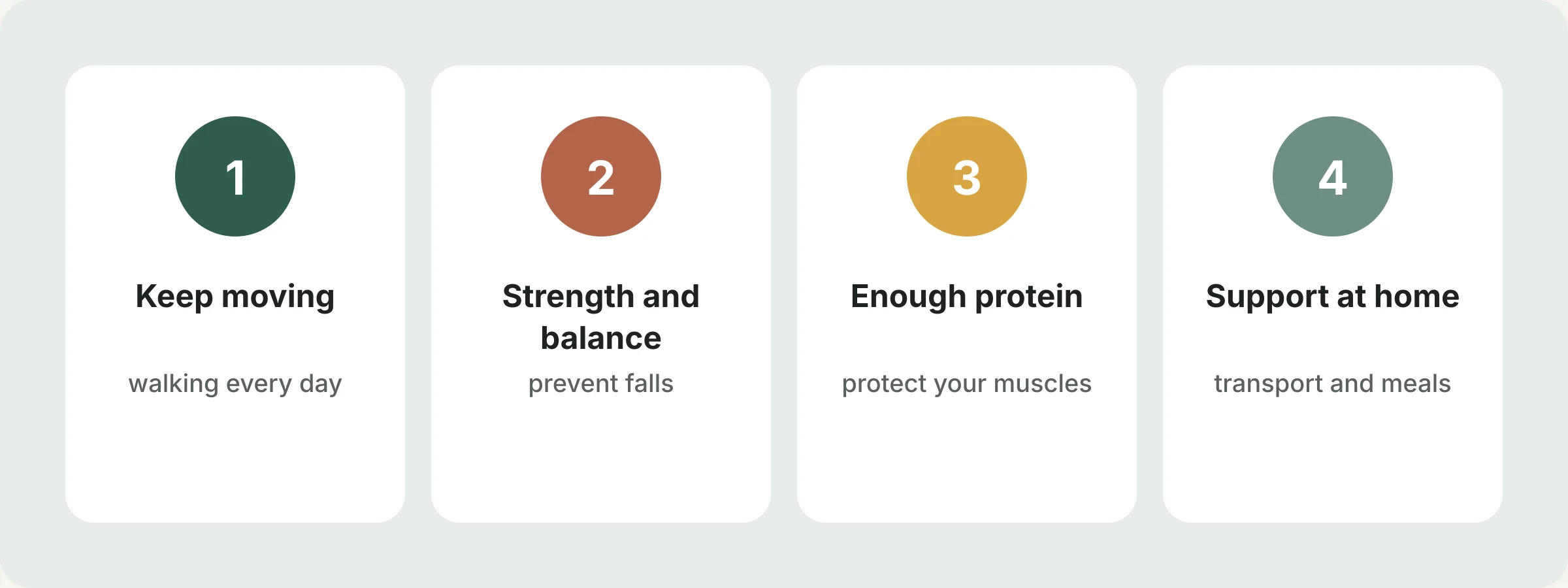
- Keep moving: walking and everyday activity help you stay fit for treatment. See a walking plan.
- Strength and balance exercises help prevent falls and keep you independent, and protect your bones.3 See strength exercises before treatment.
- Eat enough protein to protect your muscles. See protein before surgery.
- Review your medicines with your GP or pharmacist.
- Arrange support with transport, shopping and meals.
During and after treatment
- Hormone therapy is common, and can thin your bones if you take an aromatase inhibitor. See bone health after treatment.
- Tell your team about any memory problems, hearing or sight difficulties, or caring responsibilities, so they can support you.
- Keep active to reduce fatigue and keep your strength.2
- Report falls, dizziness or new pain.
Help with costs and practical support
- If you’ve reached State Pension age, you may be able to claim Attendance Allowance rather than PIP. Macmillan’s money advisers can check what you’re entitled to.4, 5
- Ask about help with travel costs and hospital transport. See financial help.
Support
- Macmillan Support Line: free on 0808 808 00 00.
- Breast Cancer Now helpline: free on 0808 800 6000.6
- Maggie’s centres and online support
Related pages
Everyone’s treatment is different, so talk to your cancer team about what is right for you.
References
- Royal College of Surgeons of England. NHS well equipped to deliver breast cancer care, but requires improvement for over 70s (National Audit of Breast Cancer in Older Patients). July 2017. www.rcseng.ac.uk/news-and-events/media-centre/press-releases/nhs-well-equipped-to-deliver-breast-cancer-care/
- Campbell KL, Winters-Stone KM, Wiskemann J, et al. Exercise guidelines for cancer survivors: consensus statement from international multidisciplinary roundtable. Medicine & Science in Sports & Exercise. 2019;51(11):2375–2390. doi.org/10.1249/MSS.0000000000002116
- Brooke-Wavell K, Skelton DA, Barker KL, et al. Strong, steady and straight: UK consensus statement on physical activity and exercise for osteoporosis. British Journal of Sports Medicine. 2022;56(15):837. bjsm.bmj.com/content/56/15/837
- Macmillan Cancer Support. Welfare rights advice. macmillan.org.uk/cancer-information-and-support/get-help/financial-help/welfare-rights-advice
- MoneyHelper. Personal Independence Payment: an introduction. www.moneyhelper.org.uk/en/benefits/benefits-if-youre-sick-disabled-or-a-carer/personal-independence-payment-an-introduction
- Breast Cancer Now. Call our helpline. breastcancernow.org/support-for-you/call-our-helpline