
The short version
- About 1 in 20 breast cancers is linked to an inherited gene change, most often in BRCA1 or BRCA2.1, 2
- If you’ve been diagnosed, you may be offered genetic testing, for example if you were diagnosed before 40, have triple negative breast cancer, or have a strong family history.2
- Results can affect your treatment options and your relatives’ risk. In England, people with Jewish ancestry can get free BRCA testing through a national NHS programme.3
What BRCA genes are
Everyone has BRCA1 and BRCA2 genes, which help repair damaged cells. A harmful change (sometimes called a fault or variant) in one of these genes increases the risk of breast, ovarian, prostate and pancreatic cancer. Having one doesn’t mean you’ll definitely get cancer.3 Cancer Research UK estimates that women with a BRCA1 change have a 60 to 90% chance of developing breast cancer in their lifetime.1
Other genes, such as PALB2, TP53 and CHEK2, can also increase risk.
Who’s offered testing
If you’ve been diagnosed with breast cancer, you may be offered genetic testing if, for example, you:2
- were diagnosed before 40
- have triple negative breast cancer, whatever your family history
- have a strong family history of breast, ovarian or related cancers
Ask your team or GP if you’re not sure. You’ll usually see a genetics team who will explain what the test means before you decide.
NHS Jewish BRCA Testing Programme: in England, anyone aged 18 or over with Jewish ancestry (at least one Jewish grandparent) can register for a free saliva test at home. People with Jewish ancestry are about six times more likely to carry a BRCA change.3
What a result can mean for you
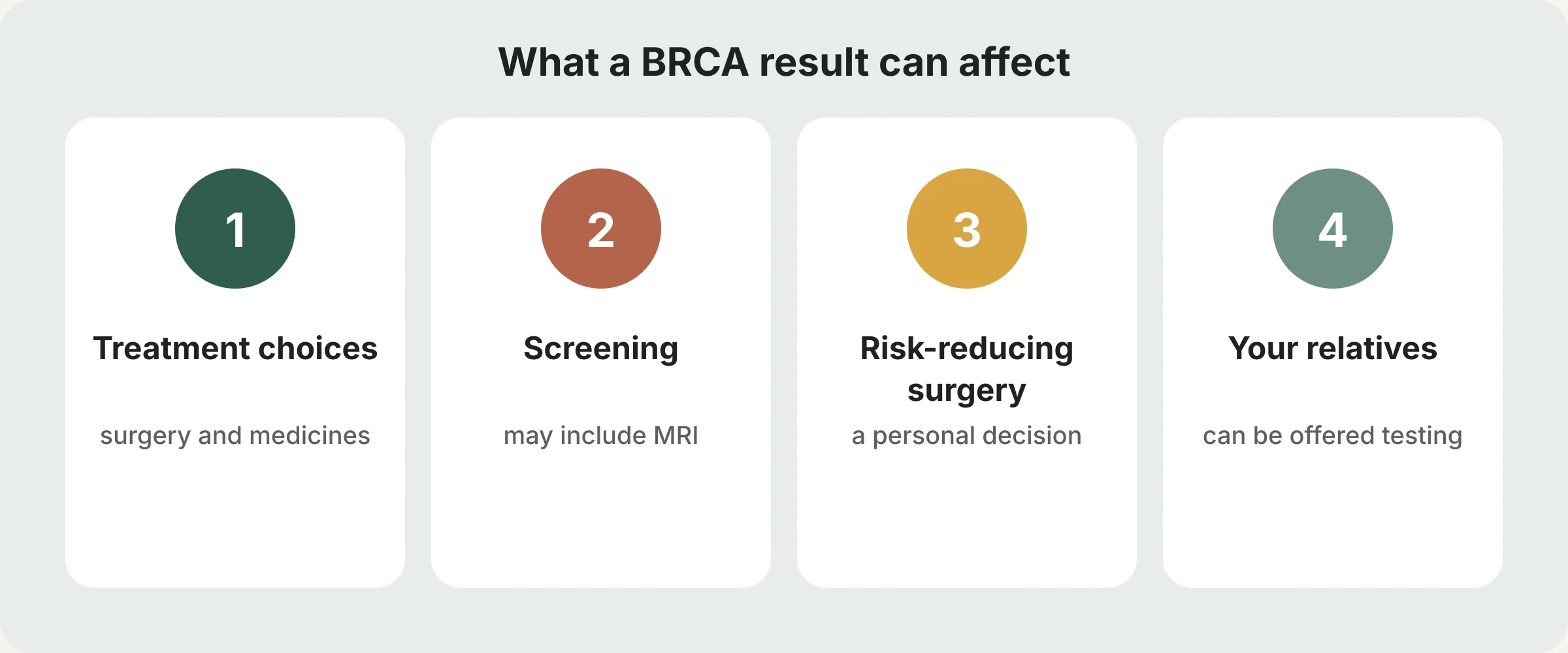
- Treatment choices: it can affect decisions about surgery, such as mastectomy rather than breast-conserving surgery.
- Extra treatment: for some people with high-risk, HER2-negative early breast cancer who’ve had chemotherapy, NICE recommends olaparib, a targeted drug for people with a BRCA change.4
- Screening: more frequent checks, which may include MRI scans.1
- Risk-reducing surgery: some people choose surgery to remove their breasts or ovaries to lower their future risk.1 This is a big decision, and you’ll have time and specialist support to think it through.
- Your family: relatives can be offered testing to find out if they carry the same change.
Getting support
- Genetic counsellors can help you think through results and decisions.
- Breast Cancer Now helpline: free on 0808 800 6000.5
- Macmillan Support Line: free on 0808 808 00 00.
Related pages
Everyone’s treatment is different, so talk to your cancer team about what is right for you.
References
- National Institute for Health and Care Excellence. What are the options for women with inherited breast cancer? www.nice.org.uk/news/feature/what-are-the-options-for-women-with-inherited-breast-cancer
- Breast Cancer Now. Breast cancer in younger women (BCC66). breastcancernow.org/media-assets/1wwkarmz/bcc66-breast-cancer-in-younger-women-web-pdf.pdf
- NHS England. NHS launches national BRCA gene testing programme to identify cancer risk early. February 2024. www.england.nhs.uk/2024/02/nhs-launches-national-brca-gene-testing-programme-to-identify-cancer-risk-early/
- National Institute for Health and Care Excellence. Olaparib for adjuvant treatment of BRCA mutation-positive HER2-negative high-risk early breast cancer after chemotherapy (TA886): information for the public. www.nice.org.uk/guidance/ta886/informationforpublic
- Breast Cancer Now. Call our helpline. breastcancernow.org/support-for-you/call-our-helpline