
The short version
- Lymphoedema is swelling caused by a build-up of lymph fluid. After breast cancer, it usually affects the arm, hand, breast or chest on the side that was treated.
- About 1 in 5 people develop arm lymphoedema after breast cancer, most within two years. The risk is higher after lymph node removal and radiotherapy to the armpit.1, 2
- Spot it early and get help quickly. It can’t be cured, but it can usually be well controlled with skin care, exercise, compression and specialist treatment.3
What is lymphoedema?
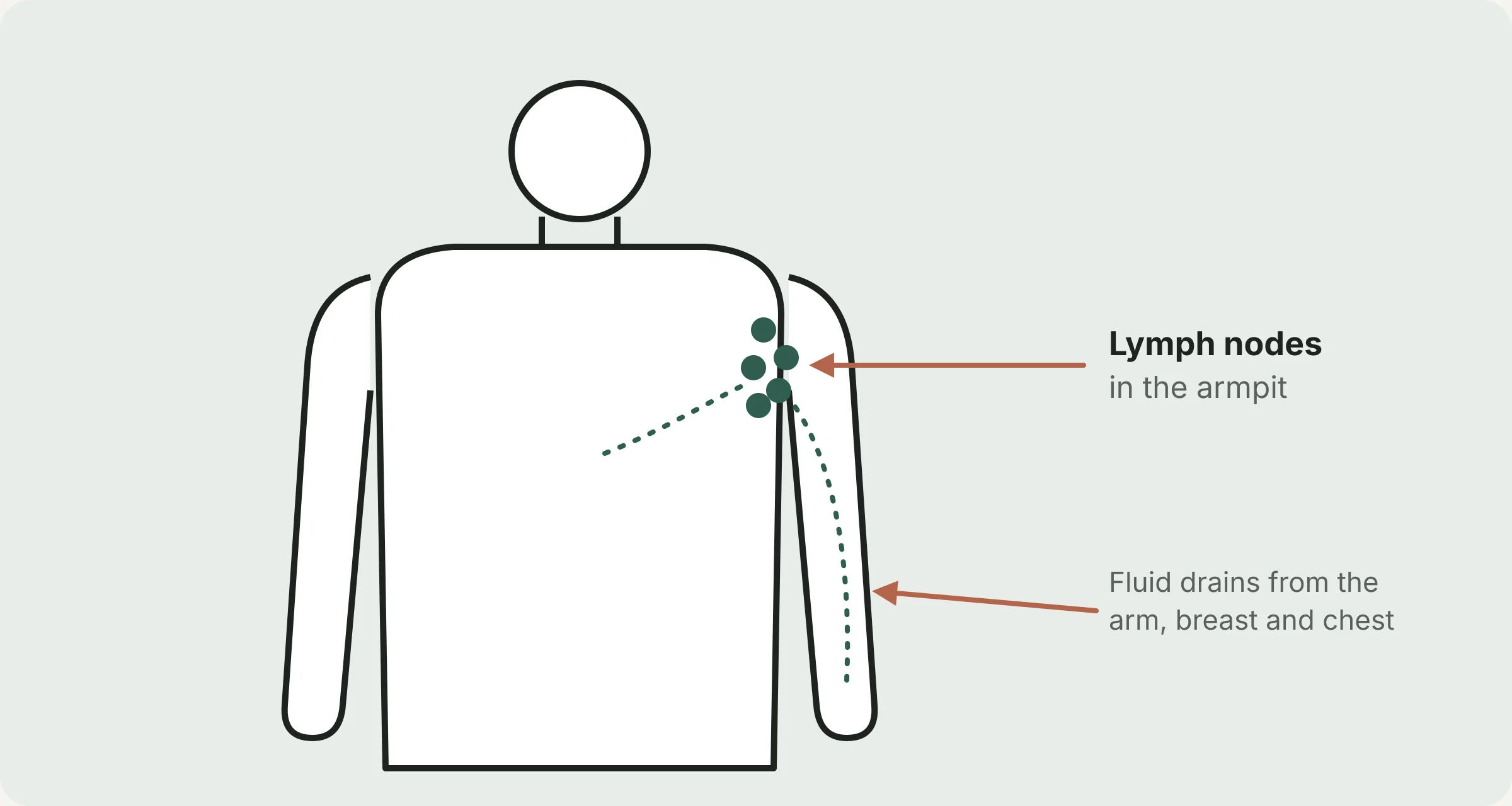
Your lymphatic system is a network of thin vessels and small glands (lymph nodes) that drains fluid from your tissues and helps fight infection. Many of the lymph nodes that drain the arm and breast are in the armpit.
If breast cancer treatment removes or damages some of these lymph nodes, fluid can drain more slowly and build up. This swelling is called lymphoedema.
Who is at risk?
A large review of international studies found that around 1 in 5 women (21%) develop arm lymphoedema after breast cancer. People who had lymph nodes removed from the armpit (axillary node clearance) were about four times as likely to develop it as those who had only a sentinel lymph node biopsy. Most people who develop it do so within the first two years.1
Your risk is higher if you have had:2
- surgery and radiotherapy to the lymph nodes
- more lymph nodes removed
- an infection (cellulitis) in the arm on the treated side
- limited movement in your arm and shoulder
Being overweight also increases the risk. Having lymph nodes removed doesn’t mean you will definitely get lymphoedema: most people don’t.2
Early signs to look out for
Lymphoedema is easier to manage when it is treated early, so it helps to know what to look for.
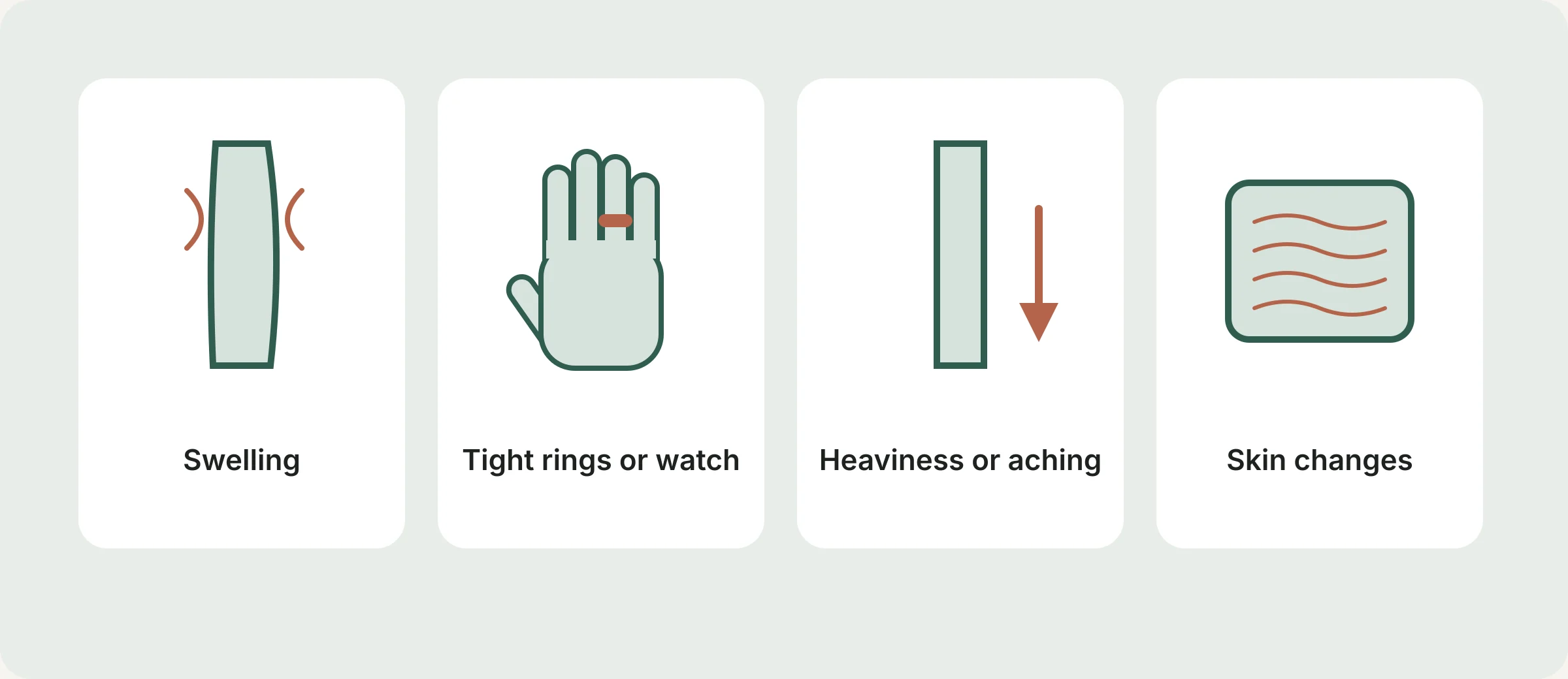
- swelling in your arm, hand, fingers, breast or chest
- rings, a watch, a bra strap or sleeves feeling tighter than usual
- a feeling of heaviness, tightness or aching in the arm, sometimes before you can see any swelling
- firmness or changes in your skin
- pins and needles or stiffness in the arm
At first, swelling may come and go. It is often worse at the end of the day, after a lot of activity or in hot weather.2
Some swelling of the breast or chest straight after surgery is part of normal healing. It still needs checking, but it is not necessarily lymphoedema.2
Contact your team as soon as possible if you notice…
- any swelling, pain, discomfort or tightness in your arm, hand, breast or chest on the treated side
- redness, heat, a rash or flu-like symptoms, which can be signs of infection (cellulitis) and may need antibiotics quickly
Contact your breast care nurse, GP or the Breast Cancer Now helpline (0808 800 6000).2
How lymphoedema is treated
If you develop lymphoedema, your GP or breast care team can refer you to an NHS lymphoedema service. Treatment usually combines:3
- skin care, to keep the skin healthy and lower the risk of infection
- exercise and movement, which help lymph fluid drain
- compression garments, such as a sleeve or glove, fitted by a specialist
- specialist massage (manual lymphatic drainage), in some cases
- compression bandaging, for a period, if the swelling is more severe
NICE has updated its breast cancer guidance (NG101) with recommendations on identifying, managing and reducing the risk of lymphoedema, so ask your team what applies to you.4
Exercise is good for lymphoedema
People used to be told to protect the affected arm and avoid lifting. The evidence now points the other way:
- In a US trial of 141 women who already had breast cancer-related lymphoedema, a year of slowly progressed, supervised weight training did not worsen swelling. Flare-ups were less common in the weight-training group (14%) than in the comparison group (29%).5
- In a second trial of 154 women at risk of lymphoedema, slowly progressed weight training did not increase the risk. Among women who had five or more lymph nodes removed, it was lower in the weight-training group (7%) than in the comparison group (22%).6
- International exercise guidelines for people with cancer confirm that exercise does not make lymphoedema worse.7
The key is to start gently and build up gradually, wear your compression garment during exercise if you have one, and stop if you notice discomfort or swelling.2 Read strength training after breast cancer.
Looking after your skin
Infections can trigger or worsen lymphoedema, so caring for your skin on the treated side really matters:2
- moisturise every day to stop the skin drying and cracking
- wear gloves for gardening, washing up and handling hot dishes
- use high-factor sunscreen and insect repellent
- take care when shaving, and with nails and cuticles
- clean any cuts or grazes straight away and use antiseptic cream
- drink plenty of fluids
Common questions
Can I have blood tests or blood pressure checks on that arm?
There is no consistent evidence that injections, blood tests, blood pressure readings or drips in the arm on the treated side cause lymphoedema. You may still prefer to use your other arm, and it’s fine to ask.2
Is it safe to fly?
There is no evidence that flying causes lymphoedema. During long journeys, gently clench and unclench your fists and shrug your shoulders now and then. If you already have a compression sleeve, ask your lymphoedema specialist whether to wear it.2
Support
- Lymphoedema Support Network: the UK patient charity for people with lymphoedema.
- British Lymphology Society: a directory of lymphoedema services.
- NHS: Lymphoedema: symptoms and treatment.
- Breast Cancer Now helpline: 0808 800 6000.
Prefer a guided plan?
A personalised rehabilitation programme can help you rebuild strength gradually and safely, with checks for lymphoedema built in. See how digital rehabilitation works.
Related pages
- Reducing your risk of lymphoedema
- Arm and shoulder exercises after breast surgery
- Exercise and lymphoedema: myths vs evidence
Everyone’s treatment is different, so talk to your cancer team about what is right for you.
References
- DiSipio T, Rye S, Newman B, Hayes S. Incidence of unilateral arm lymphoedema after breast cancer: a systematic review and meta-analysis. Lancet Oncology. 2013;14(6):500–515. doi.org/10.1016/S1470-2045(13)70076-7
- Breast Cancer Now. Reducing the risk of lymphoedema (BBC15). www.breastcancernow.org/media-assets/4icd5jsj/bbc15-reducing-the-risk-of-lymphoedema-web-pdf.pdf
- NHS. Lymphoedema. www.nhs.uk/conditions/lymphoedema/
- National Institute for Health and Care Excellence. Early and locally advanced breast cancer: diagnosis and management (NG101). www.nice.org.uk/guidance/ng101
- Schmitz KH, Ahmed RL, Troxel A, et al. Weight lifting in women with breast-cancer-related lymphedema. New England Journal of Medicine. 2009;361(7):664–673. doi.org/10.1056/NEJMoa0810118
- Schmitz KH, Ahmed RL, Troxel AB, et al. Weight lifting for women at risk for breast cancer-related lymphedema: a randomized trial. JAMA. 2010;304(24):2699–2705. doi.org/10.1001/jama.2010.1837
- Campbell KL, Winters-Stone KM, Wiskemann J, et al. Exercise guidelines for cancer survivors: consensus statement from international multidisciplinary roundtable. Medicine & Science in Sports & Exercise. 2019;51(11):2375–2390. doi.org/10.1249/MSS.0000000000002116