
The short version
- Many people return to work after breast cancer treatment. A phased return, gradually building up your hours, often works best.1
- Under the Equality Act 2010, cancer counts as a disability from the day you’re diagnosed, so your employer must consider reasonable adjustments.2 In Northern Ireland, the Disability Discrimination Act gives similar protection.3
- Access to Work can give grants for practical support that adjustments don’t cover.4
Planning your return
There’s no right time to go back. It depends on your treatment, how you feel, your job, and your finances. Some people work through treatment, and others take months off.
Before you go back:
- Talk to your team about your recovery and any side effects that might affect your work, such as fatigue, arm or shoulder problems, or difficulty concentrating.
- Ask for a fit note from your GP or hospital doctor. It can say you may be fit for work with changes, such as a phased return or different duties.1
- Meet your manager, and HR or occupational health if your workplace has them, to agree a return-to-work plan.1 Take notes, and consider bringing someone with you.
- Build your stamina in the weeks before you return. Gradually increasing your activity can help with fatigue. See our 12-week plan.
A phased return
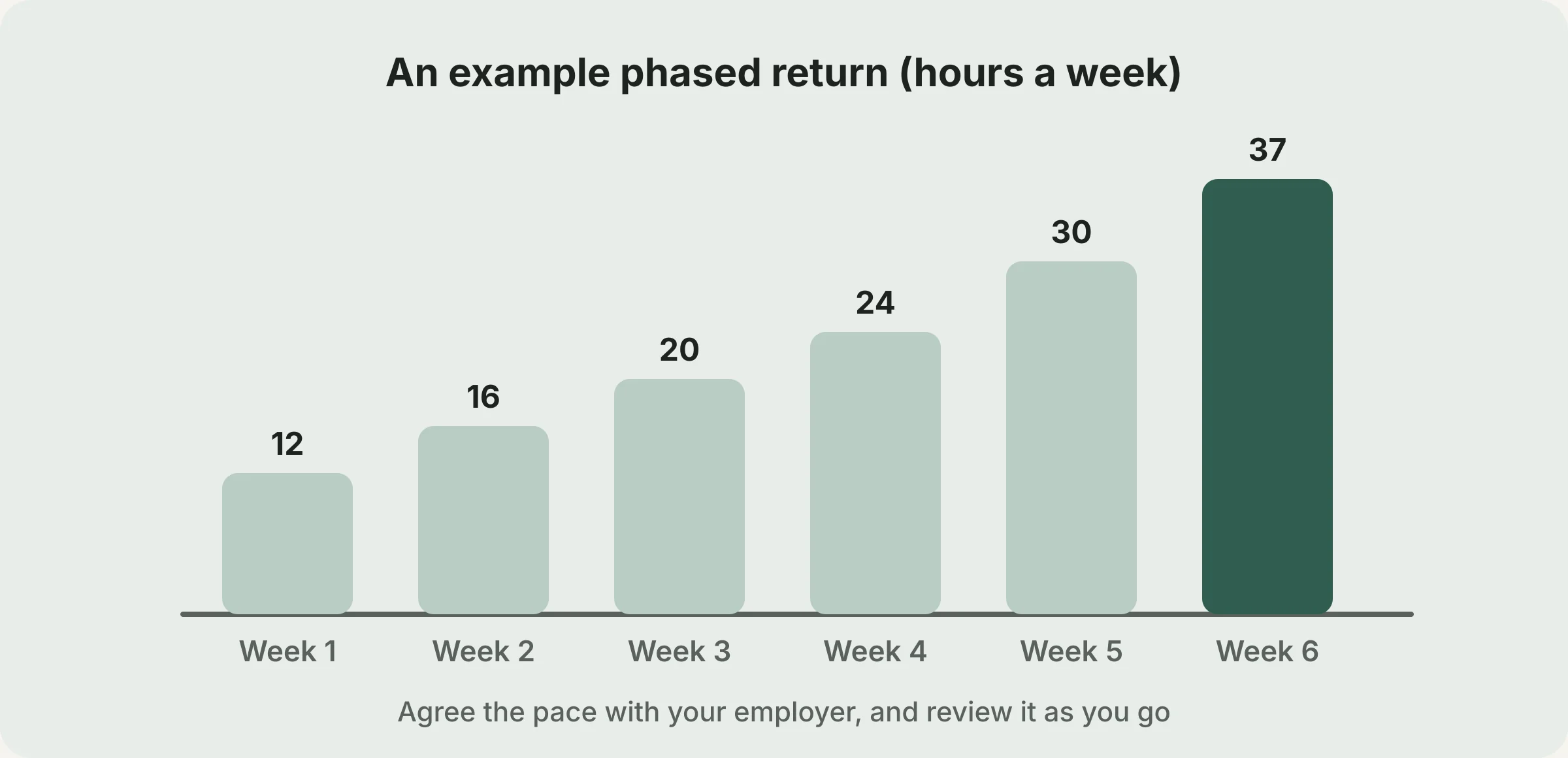
A phased return means gradually increasing your hours until you’re back to your usual pattern.1 For example, you might start with a few short days a week, then build up over several weeks. Agree the plan with your employer, keep it flexible, and meet regularly to review it.1
Reasonable adjustments
Because cancer counts as a disability under the Equality Act 2010 (in England, Scotland and Wales) from diagnosis,2 your employer must consider reasonable adjustments to help you work. These might include:
- a phased return or flexible hours1, 3
- time off for follow-up appointments and treatment3
- working from home some of the time
- changes to your duties, such as less lifting or travel
- more breaks, or a place to rest
An adjustment has to be reasonable, which depends on things like cost and the effect on the business.3 In Northern Ireland, the Disability Discrimination Act still applies to people with cancer.3
Access to Work
Access to Work is a government scheme that can pay for practical support, such as special equipment, a support worker, or help with travel to work if you can’t use public transport. It doesn’t have to be paid back and doesn’t affect your other benefits. It won’t pay for reasonable adjustments, which your employer has to make.4 Access to Work in Northern Ireland is run separately.
Managing at work
- Pace yourself. Plan demanding tasks for when you have most energy. See energy pacing.
- Use lists and reminders if your memory or concentration isn’t what it was.
- Keep moving. A short walk at lunchtime helps with energy and stiffness.
- Decide what to share. It’s up to you how much you tell colleagues.
Free advice and support
- Macmillan Support Line: free on 0808 808 00 00, including advice on work and money.1
- Your union, if you belong to one.
- Acas offers free, impartial advice on employment rights.
- Citizens Advice can help with benefits and money worries.
Prefer a guided plan?
Some personalised rehabilitation programmes help you rebuild stamina and plan your return to work, alongside exercise, nutrition, sleep and mental wellbeing. See how digital rehabilitation works.
Related pages
- Your rights at work after a cancer diagnosis
- When fatigue doesn’t go away
- Memory and concentration after treatment
Everyone’s treatment is different, so talk to your cancer team about what is right for you.
References
- Macmillan Cancer Support. Returning to work. www.macmillan.org.uk/cancer-information-and-support/impacts-of-cancer/work-and-cancer/returning-to-work
- GOV.UK. Definition of disability under the Equality Act 2010. www.gov.uk/definition-of-disability-under-equality-act-2010
- Cancer Research UK. The Disability Discrimination Act, Equality Act and cancer. www.cancerresearchuk.org/about-cancer/coping/practically/the-disability-discrimination-act-equality-act-and-cancer
- GOV.UK. Access to Work: get support if you have a disability or health condition. www.gov.uk/access-to-work