
The short version
- You can get a lot of free support from the NHS and charities. Many people do very well with it.
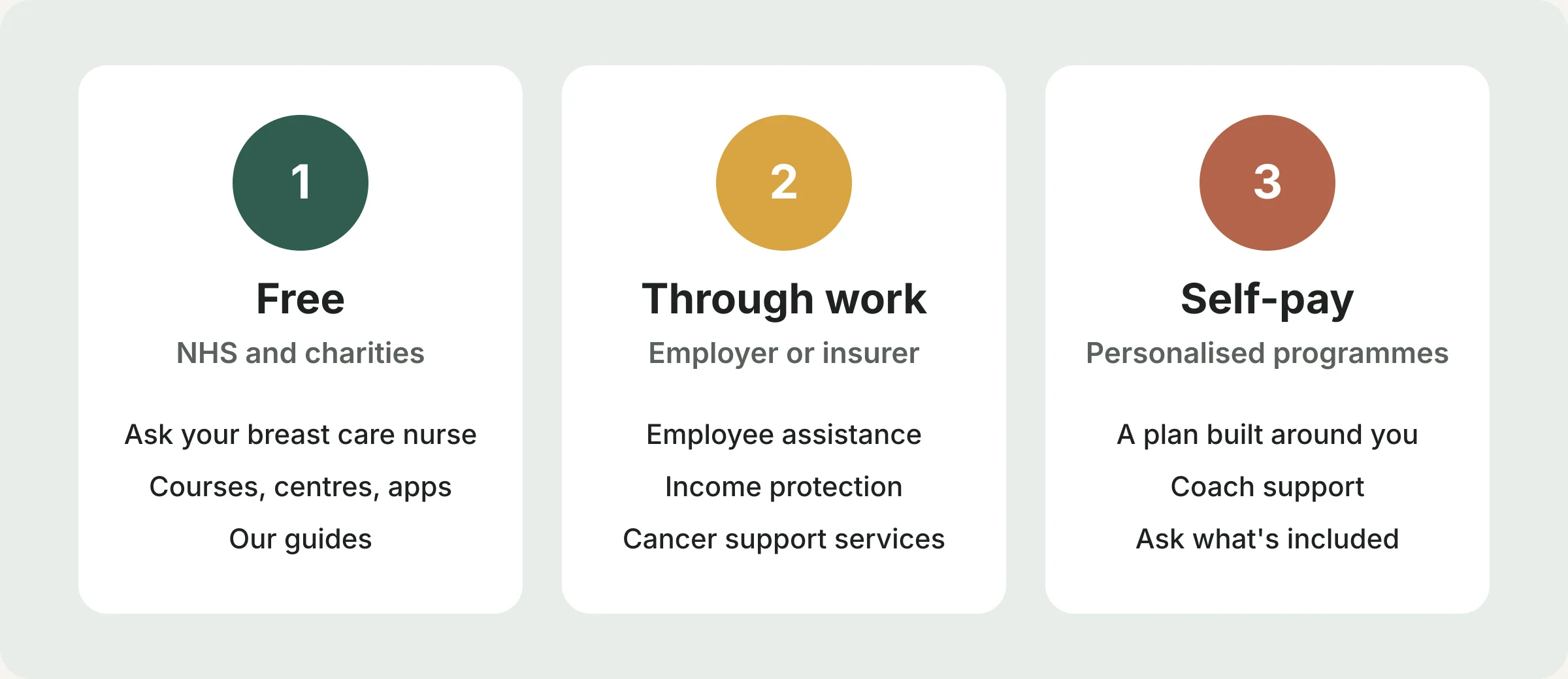
- A personalised programme can add a plan built around you, with a coach adjusting it as you go. You may get one through the NHS, your employer or insurer, or by paying yourself.
- Start by asking your team what’s available locally, then fill any gaps.
Step 1: Ask what’s free where you’re treated
Ask your breast care nurse:
- Is there an NHS prehab or rehab programme for breast cancer here?
- Can I be referred to physiotherapy, a dietitian or psychological support?
See NHS prehab and rehab across the UK and how to ask for prehab on the NHS.
Step 2: Check what your employer or insurer offers
Workplace benefits and insurance policies sometimes include cancer support, such as virtual clinics, specialist nurses or rehabilitation. See check what your employer or insurer offers.
Step 3: Use free charity support
| Free support | Good for |
|---|---|
| Moving Forward (Breast Cancer Now) | Information and meeting others after treatment |
| Penny Brohn UK | Live online sessions at any stage |
| Maggie’s | Drop-in support at centres and online |
| Sleepio and Daylight | Sleep problems and anxiety, free through Macmillan |
| b-Well | Arm and shoulder exercises after surgery |
| Our guides | For example, our 12-week strength plan |
Step 4: Decide whether you want more
A self-pay programme might be worth considering if:
- you’d like a plan built around you, rather than general advice
- you’d like regular contact with a coach who adjusts the plan as you go
- you want support with several things at once, such as fitness, eating, sleep and mood
- you aren’t offered a programme on the NHS, and don’t have one through work
It’s probably not necessary if free support is meeting your needs, or if one focused tool, such as Sleepio for sleep, solves the main problem.
Questions to ask before you pay
- What exactly is included, and for how long?
- Is there an assessment first, and is the plan personal to me?
- Will I speak to real people, such as coaches or clinicians?
- What evidence is there that it works, and is it used by the NHS?
- Is it regulated, for example registered with the MHRA or CQC?
- What does it cost, and is there a refund or suitability check?
We ask the same questions of every service. See compare UK digital prehab and rehab programmes.
A personalised option: QuestPrehab
QuestPrehab is used by NHS hospitals1 and is also open to individuals. It covers exercise, nutrition, mind and sleep, and its team has published research, including on prehabilitation in the breast cancer pathway.2 Before treatment, you can refer yourself for prehab. After treatment, QuestPrehab Recover is a four-week personalised programme, and you don’t pay until the team has confirmed it’s right for you.3 Read our QuestPrehab guide.
Other paid options include Reframe Cancer (Alvie), and private sessions with a cancer rehab personal trainer.
Related pages
- UK breast cancer tools and services directory
- How this site is funded, and why we mention QuestPrehab
Everyone’s treatment is different, so talk to your cancer team about what is right for you.
References
- QuestPrehab. QuestPrehab for the NHS. Accessed November 2026. questprehab.com/nhs/
- Wu F, Rampal T, et al. The feasibility of prehabilitation as part of the breast cancer treatment pathway. PM&R. 2021. doi.org/10.1002/pmrj.12543
- QuestPrehab. QuestPrehab Recover: personalised cancer rehabilitation. Accessed November 2026. questprehab.com/recover/