
The short version
- Save your chemotherapy helpline number in your phone. You can call it any time, day or night.1
- Know the signs of infection. Call straight away if your temperature goes over 37.5°C or below 36°C, or you suddenly feel unwell.1
- Getting as active and well nourished as you can before chemotherapy, and staying active during it, can help you cope with side effects such as fatigue.2
Practical things to do before you start
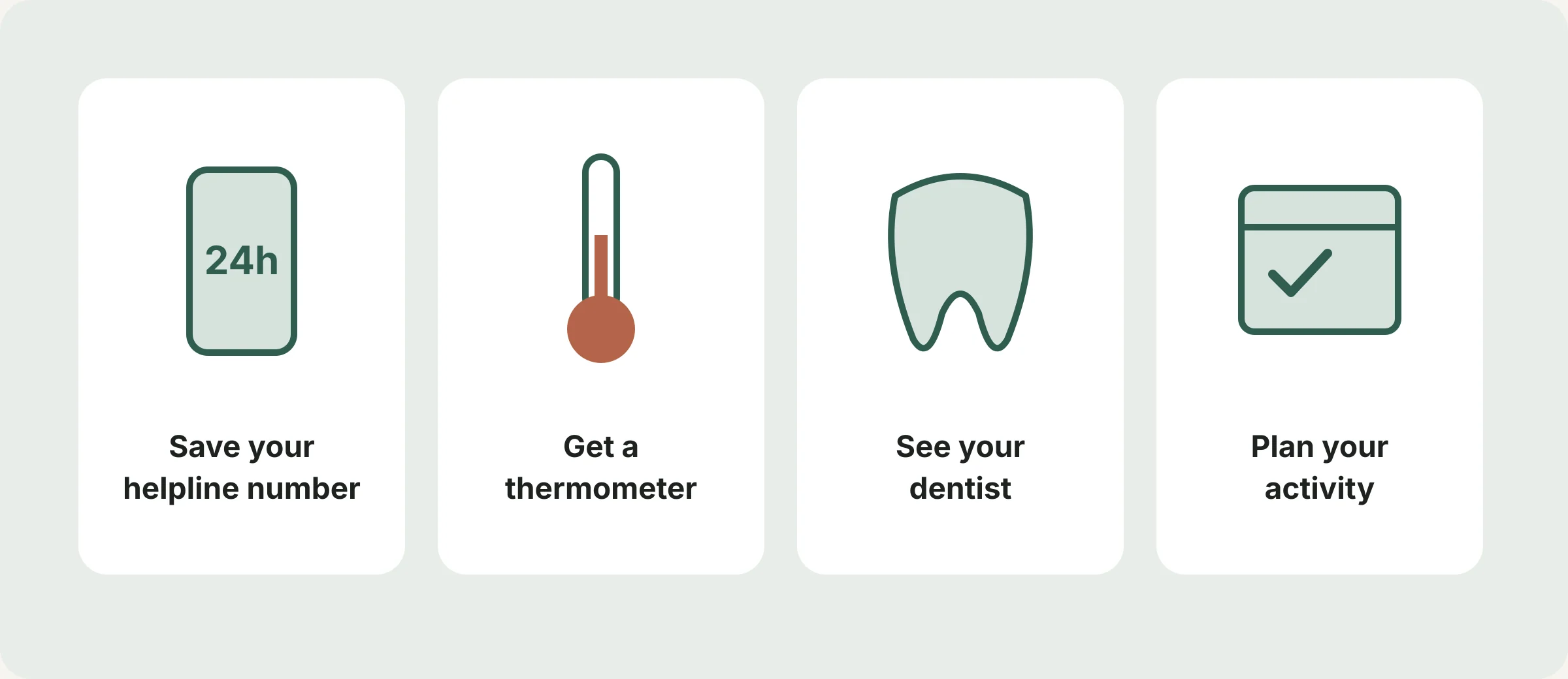
Save your helpline number
Your chemotherapy team will give you phone numbers to call if you feel unwell. You can call any time of the day or night. Save them in your phone and keep a copy somewhere easy to find.1
Get a thermometer
Chemotherapy can lower your white blood cells, which makes infections more likely and potentially serious. Have a digital thermometer at home.
Call your helpline straight away if…
- your temperature is over 37.5°C or below 36°C
- you suddenly feel unwell, even with a normal temperature
- you feel hot, cold or shivery, or have a sore throat, cough, breathlessness, diarrhoea or need to pee often
Don’t wait until the morning. These can be signs of a serious infection.1
See your dentist
Infections in the mouth can be harder to manage during chemotherapy. If you can, have a dental check-up before treatment starts. Always tell your dentist you’re having chemotherapy, and talk to your cancer team before any dental treatment.1
Ask about fertility and contraception
Chemotherapy can affect fertility. If you might want children in the future, raise this before treatment starts, as there may be options to protect your fertility.1 You’ll also need reliable contraception during treatment.
Ask about hair loss and scalp cooling
Hair loss often starts 2 to 3 weeks after starting chemotherapy and usually grows back after treatment ends. Scalp cooling (a cold cap) may reduce hair loss with some treatments. Ask your nurse whether it’s suitable for you, and about wigs or headwear.1
Find out how chemo will be given
Chemotherapy is usually given into a vein. Some people have a PICC line (a thin tube in the arm) or another central line, which stays in during treatment. If you have one, you’ll need to avoid swimming and vigorous upper-body exercise.1, 3
Check your vaccinations
Flu and COVID-19 vaccines are usually recommended. Avoid live vaccines if your immune system is weakened, and check with your team before travelling.1
Getting your body ready
Get more active
Trials in women having chemotherapy for breast cancer found that exercise protected fitness and strength and reduced fatigue.4, 5 Starting before treatment makes it easier to keep going. Build up to about 30 minutes of moderate activity three times a week, plus strength exercises.2 See our simple prehab plan and exercise during chemotherapy.
Eat well
Go into treatment as well nourished as you can, with protein at every meal. Tell your team if you’re losing weight.6 See eating well before treatment.
Planning around your treatment cycles
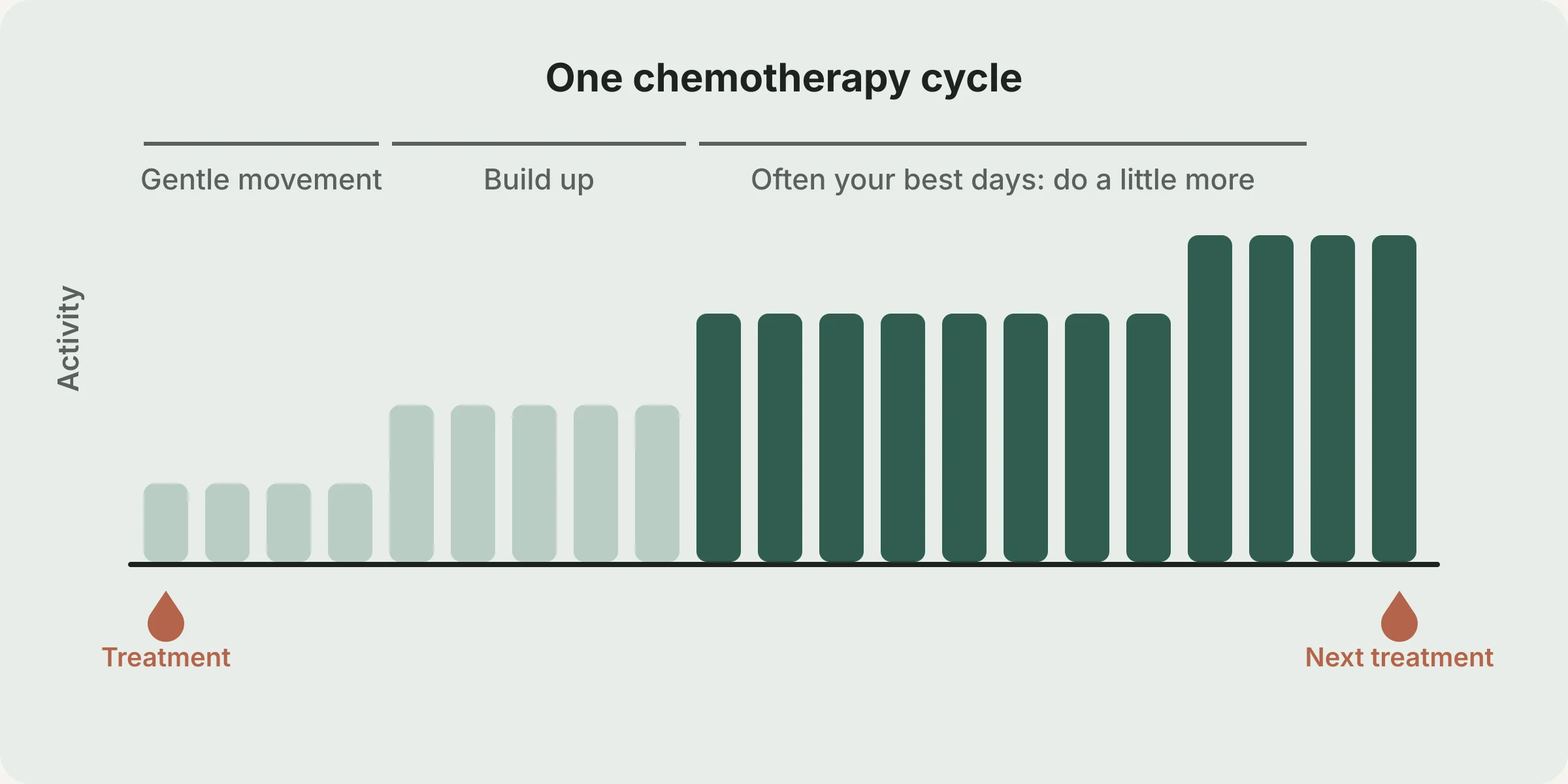
Many people find side effects follow a pattern across each cycle. You’ll often feel worst in the first few days after treatment, and better towards the next one. Once you know your pattern, you can plan activity, work and social plans for your better days.
Practical and emotional preparation
- Work and money: talk to your employer about time off or adjustments. Macmillan’s support line (0808 808 00 00) can advise on benefits and financial help.
- Help at home: line up help with meals, children and lifts to appointments.
- Support: Breast Cancer Now’s helpline (0808 800 6000) and Maggie’s centres can help with questions and worries.
Prefer a guided plan?
A personalised digital programme can plan your activity and nutrition around your chemotherapy cycles, adjusting as you go, with coaches to support you on harder days. See how digital prehab works.
Related pages
- Exercise during chemotherapy
- Managing cancer-related fatigue
- Fertility preservation before treatment
Everyone’s treatment is different, so talk to your cancer team about what is right for you.
References
- Macmillan Cancer Support. Chemotherapy (fact sheet, 2022). www.macmillan.org.uk/dfsmedia/1a6f23537f7f4519bb0cf14c45b2a629/7233-10061/mac12464-chemotherapy-final-english-for-web
- Campbell KL, Winters-Stone KM, Wiskemann J, et al. Exercise guidelines for cancer survivors: consensus statement from international multidisciplinary roundtable. Medicine & Science in Sports & Exercise. 2019;51(11):2375–2390. doi.org/10.1249/MSS.0000000000002116
- Macmillan Cancer Support. Physical activity and cancer (MAC12515, 6th edition). November 2023. www.macmillan.org.uk/dfsmedia/1a6f23537f7f4519bb0cf14c45b2a629/18459-10061/mac12515_physical-activity_E06_intpdf_02
- Courneya KS, Segal RJ, Mackey JR, et al. Effects of aerobic and resistance exercise in breast cancer patients receiving adjuvant chemotherapy: a multicenter randomized controlled trial. Journal of Clinical Oncology. 2007;25(28):4396–4404. doi.org/10.1200/JCO.2006.08.2024
- van Waart H, Stuiver MM, van Harten WH, et al. Effect of low-intensity physical activity and moderate- to high-intensity physical exercise during adjuvant chemotherapy on physical fitness, fatigue, and chemotherapy completion rates: results of the PACES randomized clinical trial. Journal of Clinical Oncology. 2015;33(17):1918–1927. doi.org/10.1200/JCO.2014.59.1081
- Muscaritoli M, Arends J, Bachmann P, et al. ESPEN practical guideline: Clinical Nutrition in cancer. Clinical Nutrition. 2021;40(5):2898–2913. doi.org/10.1016/j.clnu.2021.02.005