
The short version
- Breast reconstruction can use implants, your own tissue (a “flap”), or both. It can be done at the same time as your mastectomy, or later.1
- Recovery is longer than after a mastectomy alone, especially with flap surgery.1
- Getting fitter, stopping smoking and eating well before surgery can help your recovery. Smoking increases the risk of complications.1
Types of reconstruction
| Type | What it involves |
|---|---|
| Implant | A silicone or saline implant replaces some or all of the breast tissue. The simplest option, with a shorter operation.1 |
| Flap (your own tissue) | Skin, fat and sometimes muscle are moved from another part of your body, such as your tummy or back, to make a new breast.1 |
| Combination | Your own tissue together with an implant.1 |
Your surgeon will talk to you about which options suit you, depending on your cancer, other treatments such as radiotherapy, your body shape, your general health and what you’d prefer.1
Immediate or delayed?
- Immediate reconstruction gives you a new breast straight away, and usually means fewer operations, but you have less time to decide, and radiotherapy afterwards can change how it looks.1
- Delayed reconstruction gives you more time to think and to recover from other treatment. Recovery is generally quicker because you can prepare for it.1
If you need chemotherapy after surgery, it works best if it starts within about six weeks, so your team will consider this when planning.1
Getting ready
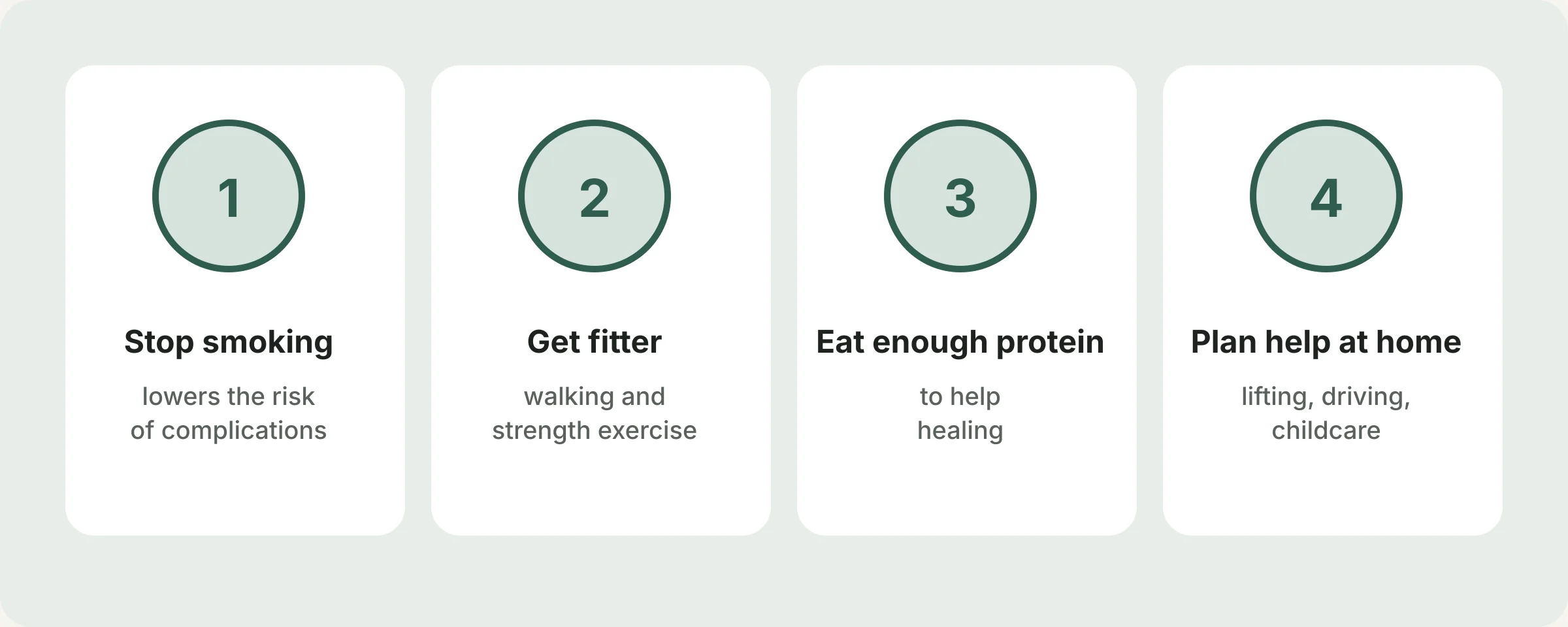
Stop smoking
Smoking reduces blood flow to the tissues, slows healing and increases the risk of infection. After flap surgery using tummy tissue, it also increases the risk of a hernia.1 Your GP or local stop smoking service can help.
Get fitter
Being fitter and stronger can help you recover from surgery. Even a few weeks of walking and strength exercise can help. See moving more before surgery and strength exercises before treatment.
- If you’re having flap surgery from your tummy, strengthening your legs will help with getting up and about afterwards, as you’ll need to protect your tummy for a while.
- If you’re having flap surgery from your back, ask your physiotherapist about shoulder exercises before and after.
Eat well
Enough protein helps healing. See protein before surgery.
Plan for recovery
- Arrange help at home, especially with lifting, shopping, children and driving.
- Ask how long you’ll be in hospital, and when you can drive, lift and return to work.
- Get front-fastening, soft bras or the post-surgery garment your team recommends.
- Ask about drains and wound care.
After surgery
Follow the exercise and lifting advice from your surgeon or physiotherapist, as it varies with the type of reconstruction. See arm and shoulder exercises after breast surgery and wound and scar care.
Questions to ask your surgeon
- Which types of reconstruction are suitable for me, and why?
- What are the risks, and how long will recovery take?
- How many operations might I need?
- How will radiotherapy affect the reconstruction?
- What exercises should I do before and after?
Support
- Breast Cancer Now helpline: free on 0808 800 6000.2
- Ask your breast care nurse whether you can talk to someone who has had the same type of reconstruction.
Prefer a guided plan?
A personalised prehab programme can help you get fitter and stronger before reconstruction, with exercise, nutrition, mind and sleep support planned around your surgery date. See how digital prehab works.
Related pages
Everyone’s treatment is different, so talk to your cancer team about what is right for you.
References
- Cancer Research UK. About breast reconstruction. www.cancerresearchuk.org/about-cancer/breast-cancer/treatment/surgery/breast-reconstruction/about
- Breast Cancer Now. Call our helpline. breastcancernow.org/support-for-you/call-our-helpline