
The short version
- Fatigue often improves in the months after treatment, but for some people it lasts months or even years.1 About one in four people treated for breast cancer still have severe fatigue after treatment.2
- See your GP or team to check for causes that can be treated, such as anaemia, thyroid problems, low mood, poor sleep or medicines.1
- The approaches with the best evidence are gradually increasing physical activity and CBT-based support.3, 4
Why fatigue can last
Cancer-related fatigue is different from ordinary tiredness. It can come on without warning and doesn’t always get better with rest. After treatment ends, it often improves considerably over the first six months,2 but for some people it continues as a long-term (late) effect.1
Several things can keep it going, often together: the after-effects of treatment, poor sleep, hot flushes, pain, low mood or worry, losing fitness, and being afraid to do too much in case it makes things worse.
Check for causes that can be treated
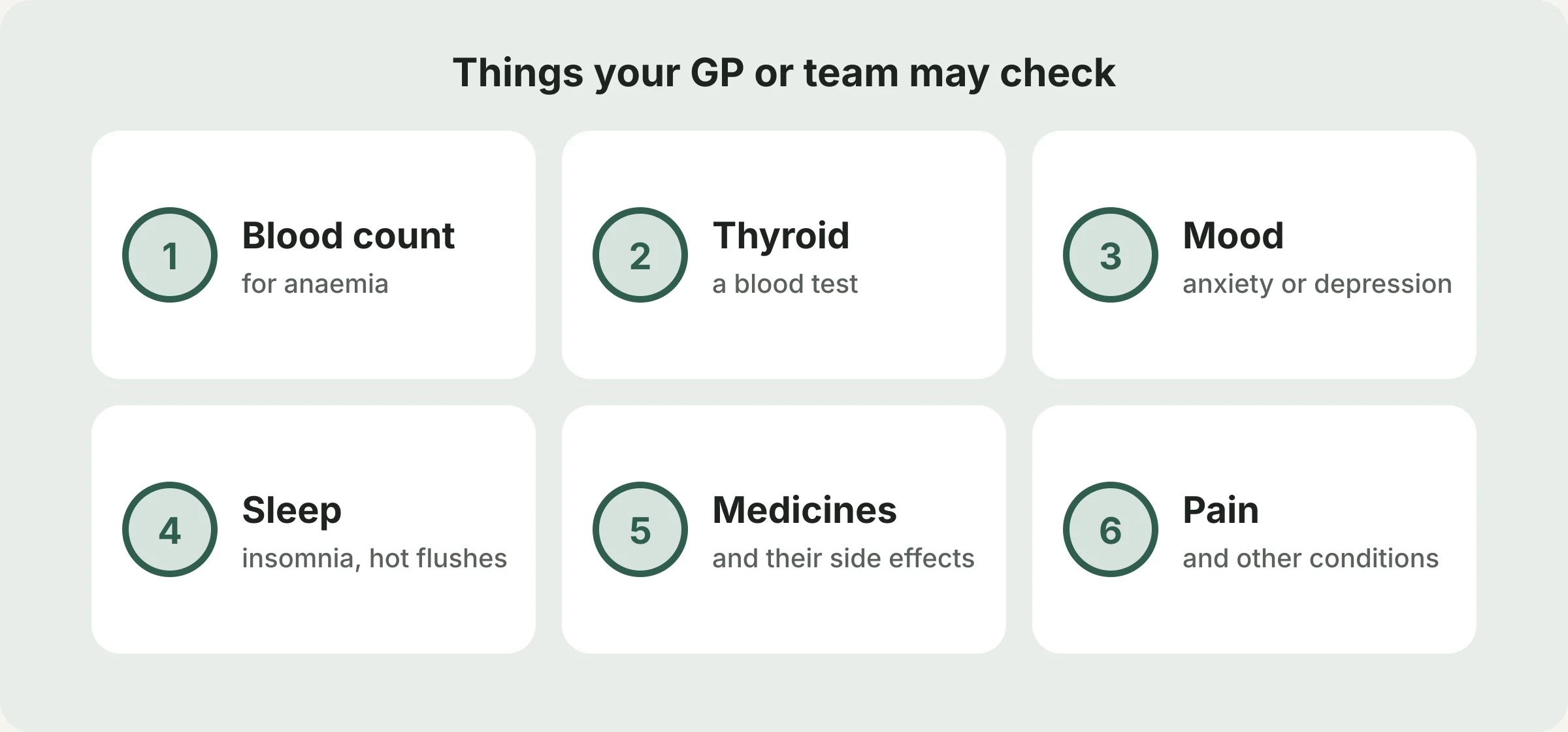
If you’re still very tired a few months after treatment, ask your GP or breast care nurse about:
- anaemia (a low red blood cell count), checked with a blood test
- thyroid function, also a blood test
- mood: anxiety and depression can make fatigue worse
- sleep: insomnia or night sweats
- medicines, including medicines for other conditions
- pain, and other conditions such as diabetes or heart problems1
What helps
Gradually increasing activity
It may seem the opposite of what you need, but being active is one of the best ways to reduce fatigue.1, 5 A large review found that exercise and psychological approaches both worked better than medicines for cancer-related fatigue.3 Guidelines suggest building up to around 30 minutes of moderate activity three times a week.6
The key is to start below what you think you can manage and build up slowly, so you don’t trigger a “boom and bust” cycle. Our 12-week plan shows how.
Pacing
Plan your days, spread out demanding tasks, and balance activity with short rests, rather than doing a lot on good days and crashing afterwards. A fatigue diary can help you spot patterns.1 See energy pacing.
CBT for fatigue
Cognitive behavioural therapy (CBT) helps you change patterns of activity, rest, sleep and thinking that keep fatigue going. In a trial of breast cancer survivors with severe fatigue at least three months after treatment, online CBT with a therapist greatly reduced fatigue compared with usual care, and also improved distress and quality of life.4 Ask your GP or team about psychological support, or refer yourself to NHS Talking Therapies in England.7
Better sleep
Poor sleep and fatigue feed each other. Sleepio, a digital CBT programme for insomnia, is free for people with cancer through Macmillan.8 See sleep problems.
Free tools and support
- Untire: an app for cancer-related fatigue. In a randomised trial it reduced fatigue in people with moderate to severe cancer-related fatigue.9
- Macmillan Support Line: free on 0808 808 00 00.
- Occupational therapists can help you manage fatigue at home and at work. Ask your team for a referral.1
See your GP or team if
- your fatigue is getting worse, not better
- you’re also breathless, dizzy, losing weight without trying, or have new pain
- you feel low or hopeless most days
Prefer a guided plan?
A personalised rehabilitation programme can build your activity up gradually around your energy levels, alongside sleep, nutrition and mental wellbeing, with a coach to support you. See how digital rehabilitation works or compare UK programmes.
Related pages
Everyone’s treatment is different, so talk to your cancer team about what is right for you.
References
- Macmillan Cancer Support. Tiredness (fatigue) and cancer. www.macmillan.org.uk/cancer-information-and-support/impacts-of-cancer/tiredness
- Abrahams HJG, Gielissen MFM, Schmits IC, et al. Risk factors, prevalence, and course of severe fatigue after breast cancer treatment: a meta-analysis involving 12 327 breast cancer survivors. Annals of Oncology. 2016;27(6):965–974. doi.org/10.1093/annonc/mdw099
- Mustian KM, Alfano CM, Heckler C, et al. Comparison of pharmaceutical, psychological, and exercise treatments for cancer-related fatigue: a meta-analysis. JAMA Oncology. 2017;3(7):961–968. doi.org/10.1001/jamaoncol.2016.6914
- Abrahams HJG, Gielissen MFM, Donders RRT, et al. The efficacy of internet-based cognitive behavioral therapy for severely fatigued survivors of breast cancer compared with care as usual: a randomized controlled trial. Cancer. 2017;123(19):3825–3834. doi.org/10.1002/cncr.30815
- Cramp F, Byron-Daniel J. Exercise for the management of cancer-related fatigue in adults. Cochrane Database of Systematic Reviews. 2012;(11):CD006145. doi.org/10.1002/14651858.CD006145.pub3
- Campbell KL, Winters-Stone KM, Wiskemann J, et al. Exercise guidelines for cancer survivors: consensus statement from international multidisciplinary roundtable. Medicine & Science in Sports & Exercise. 2019;51(11):2375–2390. doi.org/10.1249/MSS.0000000000002116
- NHS. NHS talking therapies for anxiety and depression. www.nhs.uk/mental-health/talking-therapies-medicine-treatments/talking-therapies-and-counselling/nhs-talking-therapies/
- Macmillan Cancer Support and Big Health. Free Sleepio for people with cancer. www.sleepio.com/macmillan
- Spahrkäs SS, Looijmans A, Sanderman R, Hagedoorn M. Beating cancer-related fatigue with the Untire mobile app: results from a waiting-list randomized controlled trial. Psycho-Oncology. 2020;29(11):1823–1834. doi.org/10.1002/pon.5492