
The short version
- For most people, exercise during chemotherapy is safe and helps. It can reduce fatigue, protect fitness and strength, and lift mood.1
- Aim for little and often: short walks and simple strength exercises, adjusted to how you feel each day. Rest on bad days without guilt.
- Stop and call your team if you have a temperature, chest pain, breathlessness, dizziness or anything that worries you.
Is it safe to exercise during chemotherapy?
For a long time, people having chemotherapy were told to rest. Research now shows that for most people, staying active is safe and beneficial. An international group of experts reviewed the evidence in 2019 and concluded that exercise during and after cancer treatment improves fatigue, anxiety, depression, physical function and quality of life, and does not make lymphoedema worse.1
Two large trials in women with breast cancer having chemotherapy found:
- Women who did supervised aerobic or resistance exercise during chemotherapy improved their fitness or strength and self-esteem compared with usual care. Slightly more of them completed their planned chemotherapy, although the researchers said this needs confirming.2
- A moderate- to high-intensity supervised programme reduced physical fatigue, and fewer women in that group needed their chemotherapy dose adjusted. A gentler home-based programme also helped protect fitness and physical function.3
You don’t need to train hard to benefit. Any movement is better than none.
How much should I aim for?
The UK guideline for all adults is 150 minutes of moderate activity a week (for example 30 minutes on five days), plus strength exercises on two days.4 For people with cancer, international guidance suggests that about 30 minutes of moderate activity three times a week, plus strength exercises twice a week, is enough to help with fatigue and wellbeing.1
During chemotherapy these are goals to work towards, not targets you must hit. Many people find it helps to plan around their treatment cycle:
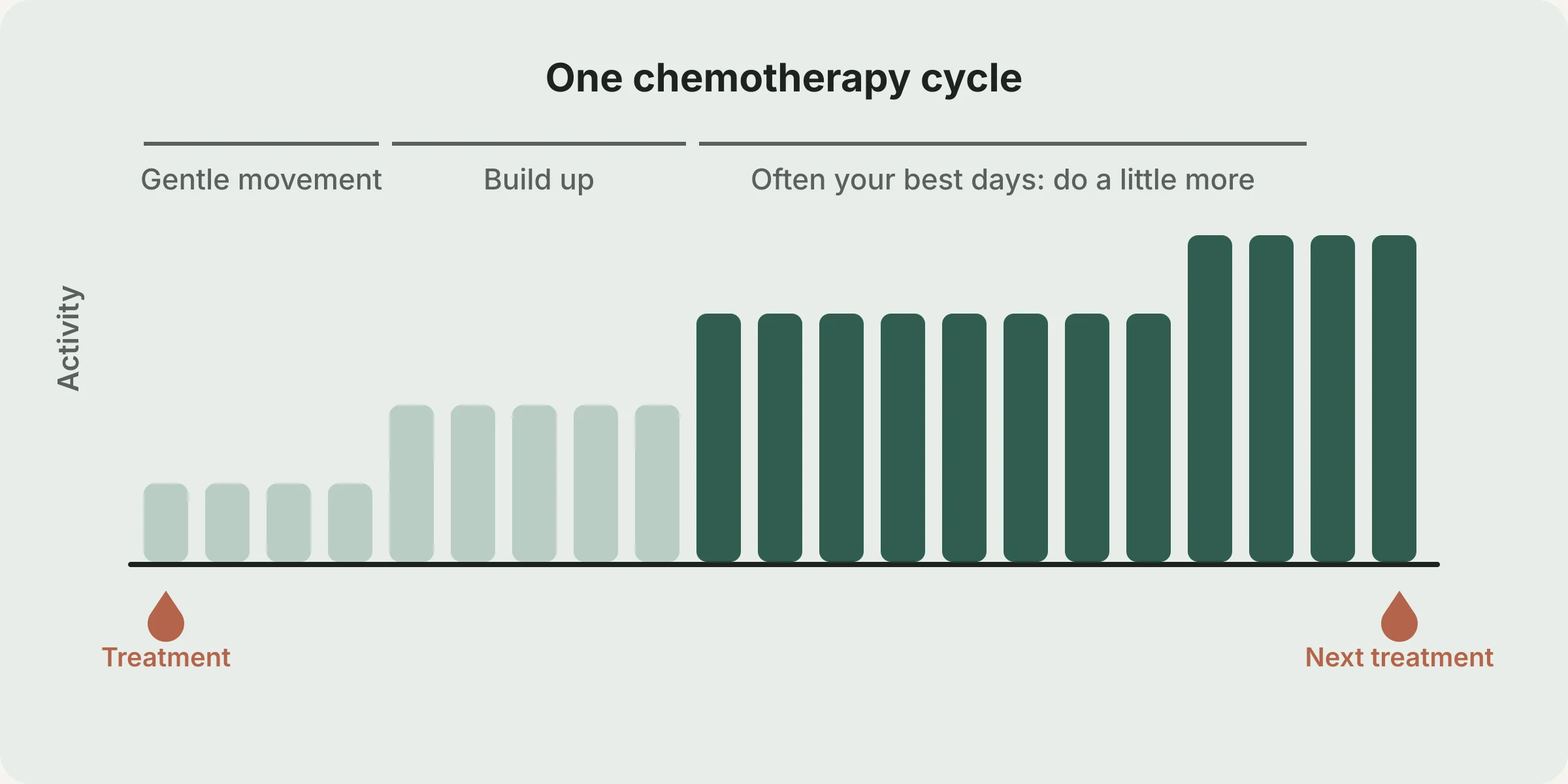
- The first few days after treatment: gentle movement only, such as short walks around the house or garden and stretches.
- The middle of the cycle: build up walks and add simple strength exercises.
- Before your next treatment: often your best days. Do a little more if you feel able.
“Moderate” means you are breathing faster but can still talk. If you can’t speak in full sentences, slow down.
What kind of exercise?
Walking and other aerobic activity
Walking is easy to fit in and easy to adjust. Cycling (including an exercise bike), dancing and gentle swimming also count, but check the swimming advice below.
Strength exercises
Keeping your muscles strong helps you stay independent and supports your bones. Try:
- sit-to-stand from a chair, 5 to 10 times
- wall press-ups
- step-ups on the bottom stair, holding the banister
- calf raises, holding onto a worktop
If you’ve had breast or lymph node surgery, keep doing your arm and shoulder exercises and build up any upper-body strength work gradually.
Balance and flexibility
Gentle yoga, Pilates or tai chi can help with stiffness and balance, especially if chemotherapy has affected the feeling in your feet.
Adapting to side effects
| If you have… | Try this |
|---|---|
| Fatigue | Short, gentle sessions. Activity often improves fatigue. Read managing cancer-related fatigue. |
| Low white blood cells (higher infection risk) | Avoid busy places such as gyms and swimming pools. Exercise at home or outdoors instead.5 |
| Low platelets (bruising or bleeding) | Exercise gently and avoid high-impact or contact activities.5 |
| Anaemia | Expect to be more breathless. Rest as needed.5 |
| Numb or tingling feet (neuropathy) | Choose an exercise bike or seated exercises rather than uneven walking. Check your feet for cuts or blisters.5 |
| A PICC or central line | Avoid swimming and vigorous upper-body exercise.5 |
| Nausea | Try gentle movement at the time of day you feel best. Fresh air often helps. |
Stop and get help if…
Stop exercising and contact your acute oncology or chemotherapy helpline straight away if you have:
- a high temperature (usually 37.5°C or above, or the level your team has given you), or you feel shivery or unwell
- chest pain, a racing heart or difficulty breathing
- dizziness or feeling faint
- new or unusual bone, back or muscle pain
- a headache that won’t go away
Some muscle soreness and tiredness for a day or two after exercise is normal. If you feel very sore or exhausted, do less next time.5
Keeping going
- Plan it. Put short sessions in your diary like appointments.
- Keep a simple diary of what you did and how you felt. It helps you spot patterns across your treatment cycle.
- Move with someone. A friend, a family member or an online class can help on low-motivation days.
- Celebrate small wins. A walk to the end of the road on a bad day counts.
Prefer a guided plan?
A personalised digital programme can plan your activity around your chemotherapy cycle, with daily steps and coaches who adjust the plan as you go. See how digital prehab and rehab work, or compare UK programmes.
Free support near you
- Macmillan Move More: free activity sessions in many areas, run by instructors trained in cancer rehabilitation.
- Penny Brohn UK: free live online sessions, including strength and stamina.
- Cancer rehab personal trainers: qualified trainers you can pay to work with one to one.
Related pages
- Managing cancer-related fatigue
- When to rest: exercise safety and red flags
- How much exercise is recommended?
Everyone’s treatment is different, so talk to your cancer team about what is right for you.
References
- Campbell KL, Winters-Stone KM, Wiskemann J, et al. Exercise guidelines for cancer survivors: consensus statement from international multidisciplinary roundtable. Medicine & Science in Sports & Exercise. 2019;51(11):2375–2390. doi.org/10.1249/MSS.0000000000002116
- Courneya KS, Segal RJ, Mackey JR, et al. Effects of aerobic and resistance exercise in breast cancer patients receiving adjuvant chemotherapy: a multicenter randomized controlled trial. Journal of Clinical Oncology. 2007;25(28):4396–4404. doi.org/10.1200/JCO.2006.08.2024
- van Waart H, Stuiver MM, van Harten WH, et al. Effect of low-intensity physical activity and moderate- to high-intensity physical exercise during adjuvant chemotherapy on physical fitness, fatigue, and chemotherapy completion rates: results of the PACES randomized clinical trial. Journal of Clinical Oncology. 2015;33(17):1918–1927. doi.org/10.1200/JCO.2014.59.1081
- UK Chief Medical Officers. Physical activity guidelines for adults and older adults. 2019. www.gov.uk/government/publications/physical-activity-guidelines-adults-and-older-adults/physical-activity-for-adults-and-older-adults-19-and-over-text-of-the-infographic
- Macmillan Cancer Support. Physical activity and cancer (MAC12515, 6th edition). November 2023. www.macmillan.org.uk/dfsmedia/1a6f23537f7f4519bb0cf14c45b2a629/18459-10061/mac12515_physical-activity_E06_intpdf_02