
The short version
- Many people find the end of hospital treatment harder than they expected. Feeling tired, low, anxious or a bit lost is common and normal.
- Before you leave hospital care, ask for a treatment summary, your contact numbers and your follow-up plan.1, 2
- Recovery takes time. Small, regular steps (moving, eating well, resting and talking) help most.
Why the end of treatment can feel hard
For months, your life may have been organised around appointments, and you had a team watching over you. When that stops, it can feel as if the safety net has gone, just when you’re still tired and your body has changed. You may also feel that other people expect you to be “back to normal”.
It’s common to feel:
- relieved, and also anxious about the cancer coming back
- tired, sometimes for months
- low, or flat, as the adrenaline of treatment wears off
- unsure about your body, your work or your relationships
These feelings usually ease with time. If they don’t, or they’re getting worse, there is help (see below).
What to ask for before you leave hospital care
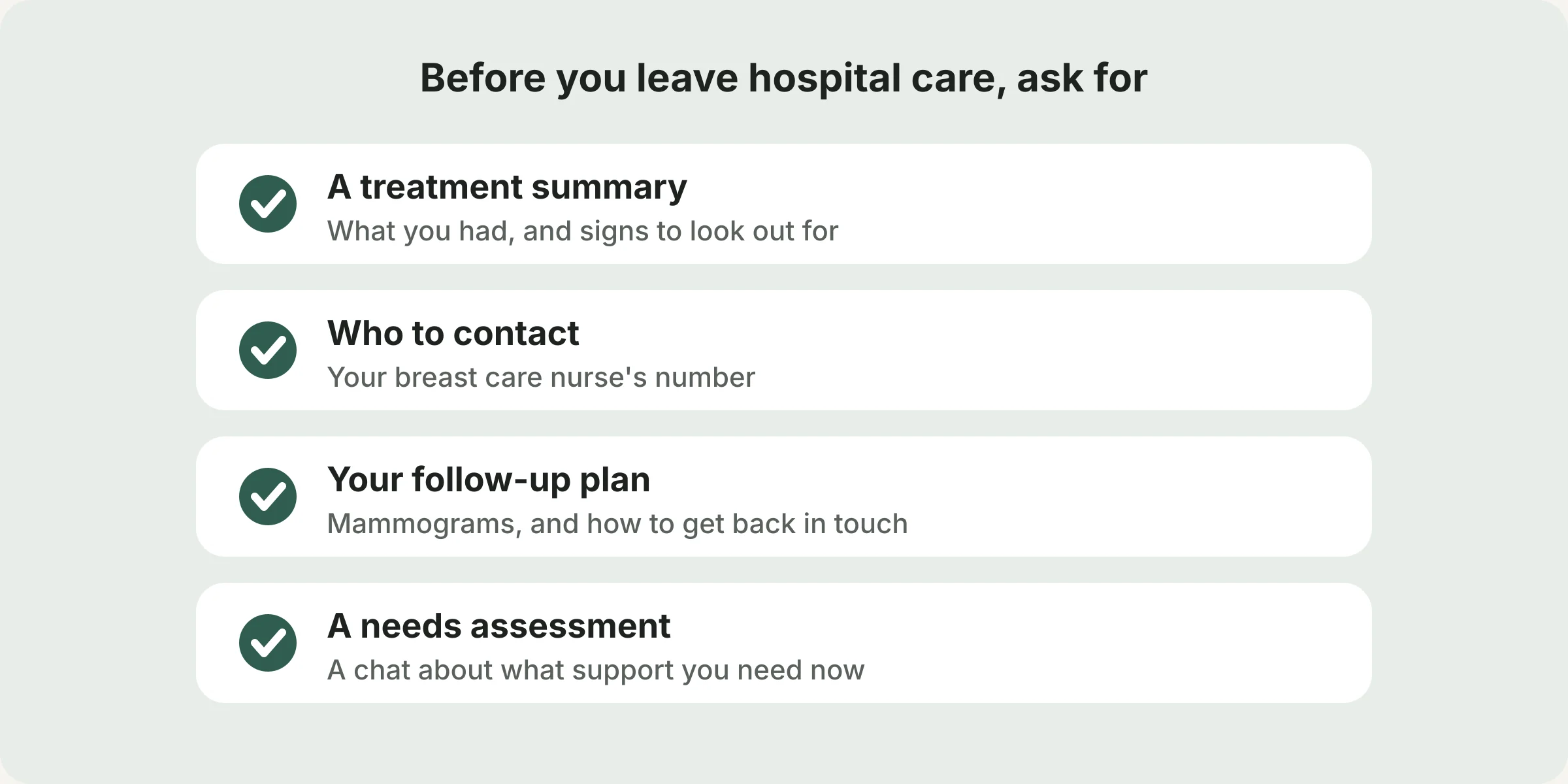
- An end of treatment summary. This records the treatment you had, possible side effects, the signs and symptoms to look out for, and who to contact. A copy goes to your GP.1
- Contact numbers for your breast care nurse or team, and when to use them.
- Your follow-up plan, including mammograms, which are usually every year for five years.2 Read more about follow-up care.
- A Holistic Needs Assessment (HNA). This is a conversation, often with your nurse, about your physical, emotional and practical needs, leading to a care plan.3
Steps that help
- Move a little every day. Being active after treatment improves fatigue, anxiety, low mood and physical function.4 Start gently and build up: see our 12-week plan.
- Eat regular, balanced meals, and talk to your team if your weight has changed a lot. See managing your weight after treatment.
- Rest without stopping altogether. Balance rest with activity. See when fatigue doesn’t go away.
- Talk to people. Friends and family, others who have been through it, or a professional.
- Go easy on yourself. Recovery is rarely a straight line.
Free support
- Moving Forward from Breast Cancer Now is a free course for people who have finished hospital treatment for primary breast cancer. It runs online or in person over two half-day sessions, and covers wellbeing, activity, eating well, menopausal symptoms and worries about the cancer coming back.5
- Breast Cancer Now helpline: free on 0808 800 6000.
- Macmillan Support Line: free on 0808 808 00 00.
- NHS Talking Therapies for anxiety and low mood. You can refer yourself in England.6
When to get help
Contact your GP or breast care nurse if you feel low or anxious most days for more than two weeks, if you can’t sleep or cope with everyday life, or if you notice any new symptoms that don’t go away. If you’re thinking about harming yourself, call 999 or NHS 111 (option 2 for mental health in England), or contact Samaritans free on 116 123.
Prefer a guided plan?
A personalised rehabilitation programme can help you rebuild strength, energy and confidence step by step, with a coach to support you. See how digital rehabilitation works or read what cancer rehabilitation is.
Related pages
- Recovering after breast cancer treatment
- Living with fear of recurrence
- Returning to work after breast cancer
Everyone’s treatment is different, so talk to your cancer team about what is right for you.
References
- Calderdale and Huddersfield NHS Foundation Trust. End of treatment summary. cht.nhs.uk/services/clinical-services/oncology/end-of-treatment-summary
- Macmillan Cancer Support. Follow-up after breast cancer treatment. www.macmillan.org.uk/cancer-information-and-support/breast-cancer/follow-up-after-breast-cancer-treatment
- Macmillan Cancer Support. What is a Holistic Needs Assessment (HNA)? www.macmillan.org.uk/cancer-information-and-support/treatment/coping-with-treatment/holistic-needs-assessment-hna
- Campbell KL, Winters-Stone KM, Wiskemann J, et al. Exercise guidelines for cancer survivors: consensus statement from international multidisciplinary roundtable. Medicine & Science in Sports & Exercise. 2019;51(11):2375–2390. doi.org/10.1249/MSS.0000000000002116
- Breast Cancer Now. Moving Forward: support after breast cancer treatment. breastcancernow.org/support-for-you/moving-forward
- NHS. NHS talking therapies for anxiety and depression. www.nhs.uk/mental-health/talking-therapies-medicine-treatments/talking-therapies-and-counselling/nhs-talking-therapies/